Credit Scoring Is Changing: 3 Things Homebuyers Should Know

Credit Scoring Is Changing: 3 Things Homebuyers Should Know

Credit Scoring Is Changing: 3 Things Homebuyers Should Know Simplifying The Market

Quick, what credit score do you need to buy a home? If a number pops into your head, there’s a pretty good chance it’s wrong. And the right answer is getting harder to pin down, because the way credit scores are determined and delivered is changing – for the better.

Here’s what you need to know in today’s changing credit climate.

#1  Most People Are Guessing 

Fannie Mae has been tracking consumer perceptions about mortgage requirements since 2015 and found that consumers consistently overestimated the minimum credit score lenders required to qualify for a mortgage. As recently as 2023, the average guess was 652.

In reality, the long-standing benchmark for loans backed by Fannie Mae and Freddie Mac is lower, at 620, and today even that isn’t a hard rule for every mortgage they back. 

Like the Fannie Mae research, a recent survey from Veterans United found consumers continue to overestimate what it takes to qualify for a home loan:

a blue and white survey

The takeaway? Guessing wrong can cost you. 

A renter who assumes their score is too low and they can’t qualify for a mortgage may never take steps to find out for sure.

#2  Credit Rules Are Changing

For decades, the mortgage industry relied on one set of scores – Classic FICO. Thanks to a push to promote competition, make credit scoring more inclusive, and help more Americans become homeowners, the Federal Housing Finance Agency (FHFA) has approved the use of new credit score models such as FICO 10T and VantageScore 4.0.

A different model can mean a different number for the same person. VantageScore says its model can score about 33 million adults that the Classic FICO’s model can’t. So the score you saw on an app last month may not be the one your lender pulls.

Remember: the models may be new, but the basics haven’t changed.

#3  Do Your Part And Partner With A Pro

Your credit score is important – no matter how it’s measured. Following the same basic rules will benefit your profile in the old and new score models:
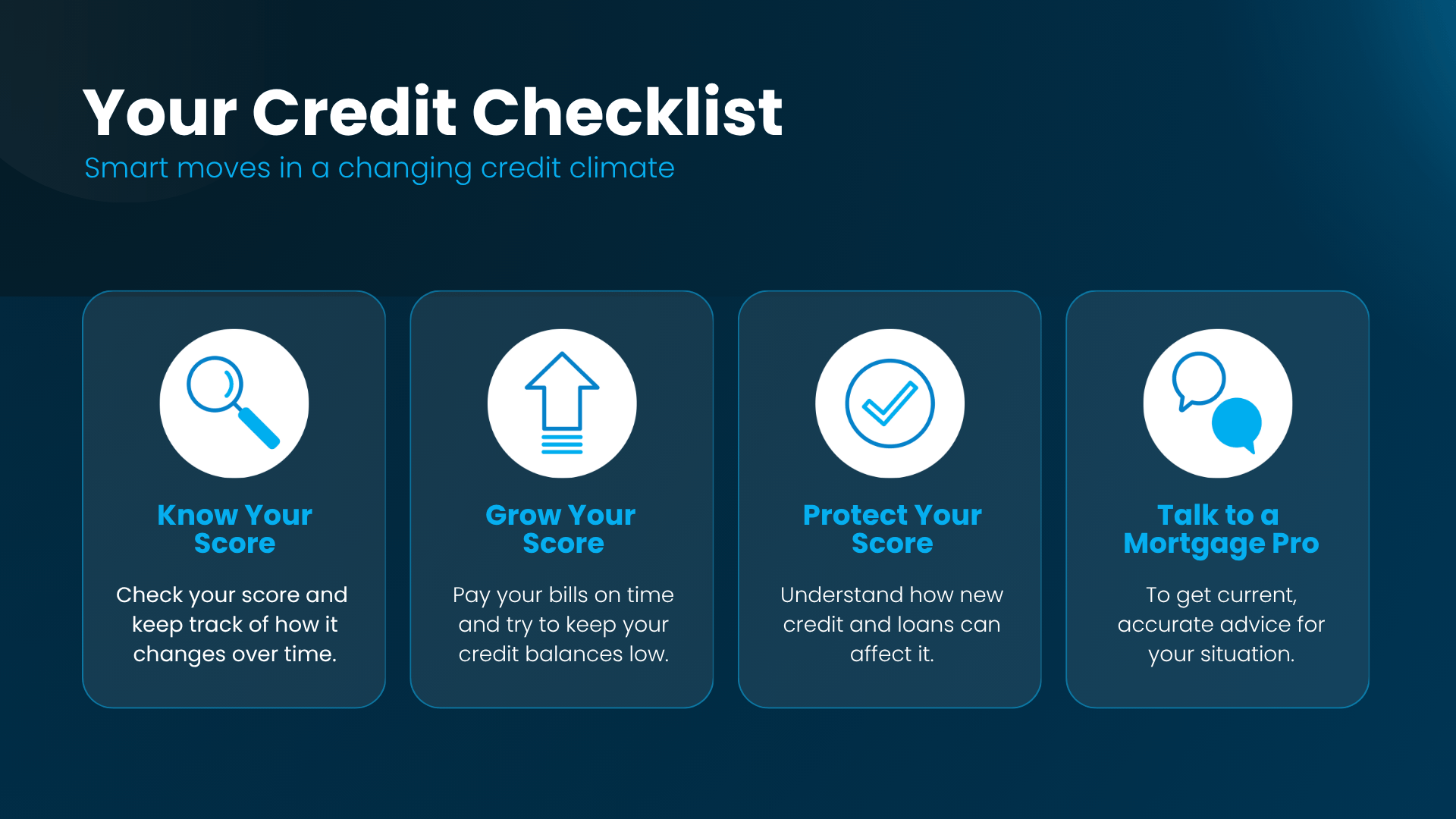
a screen shot of a credit checklist

Because while credit models may change, the general advice for you to improve your score doesn’t. Financial awareness and consistency mixed with a little willpower can go a long way.

Bottom Line

Don’t make credit or homebuying decisions from a chart, an app, or a friend’s advice. With the rules shifting and so many misconceptions out there, it’s never too early to talk to a professional loan officer for advice on credit, budgeting, and what it would take to qualify for a mortgage.

You may be closer to owning a home than you think.

Why More Buyers Are Turning To Adjustable-Rate Mortgages Today

Why More Buyers Are Turning To Adjustable-Rate Mortgages Today

Why More Buyers Are Turning To Adjustable-Rate Mortgages Today Simplifying The Market

When mortgage rates climb, buying a home can start to feel like trying to hit a moving target. Every jump in rates makes monthly payments bigger, and that pushes a lot of buyers to look for another way in.

More and more of them are finding it in the adjustable-rate mortgage, or ARM.

The ARM Option  

Here’s how an ARM differs from a more traditional mortgage. With a regular fixed-rate mortgage, your rate stays the same for your whole loan. But with an ARM, your rate is locked for the first few years, then it can move up or down based on market conditions.

Some people don’t like that level of uncertainty – and that’s okay. But others are drawn to this option specifically because there’s usually a lower rate to start when you opt for an ARM. And in an affordability-strapped market, that’s going to gain popularity. 

Bankrate recently found that, in September, rates for ARM products were over a full percentage point lower than a regular fixed-rate loan. Depending on the ARM product, that can make a difference of $150-300 in the monthly payment on a median-priced home. 

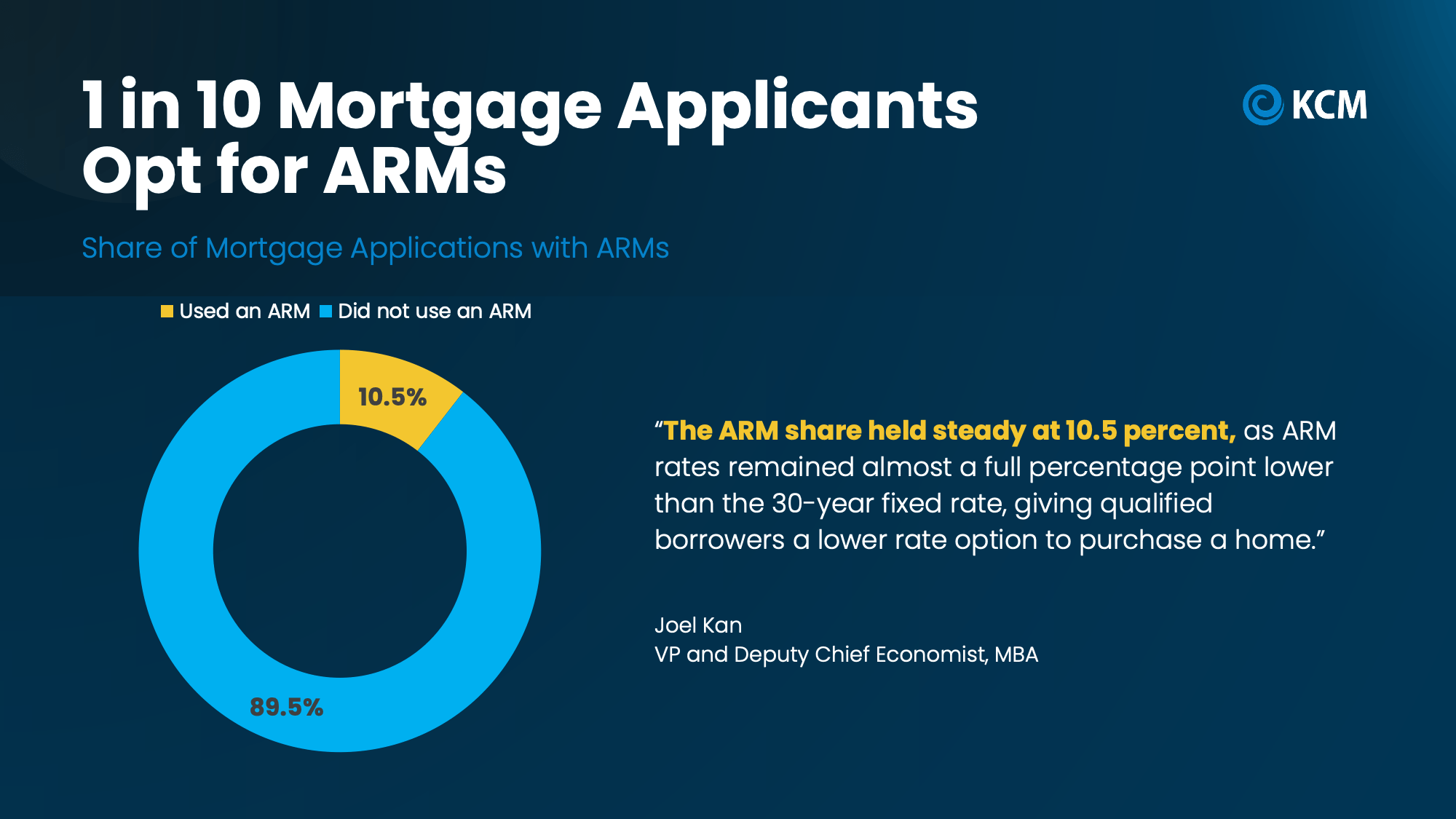
And for some buyers, that’s enough to turn “not right now” into “let’s do this.” You can see it in the numbers. Data from the Mortgage Bankers Association (MBA) shows that, in October, roughly 1 in 10 people applying for a mortgage chose an ARM (see graph below):

a blue pie chart with text

If you think you may want to consider this yourself, here’s what you need to know about how it works.

The 5/1 ARM

An ARM is like a phone or cable plan that has an introductory deal for new customers. You start out at a lower price, and then it adjusts after a specified amount of time. A popular loan is the 5/1 ARM.

The “5” means your introductory rate is locked for the first five years, and the “1” means that the rate can change every year after that. The rate change is called the “reset.” And here’s the really important part.

When your rate resets, your mortgage payment could go up or down. The good news is that most ARMs have caps, which are limits on how much your rate can rise each year and over the life of the loan. But either way, you have to be ready. 

The Upsides and Potential Downsides

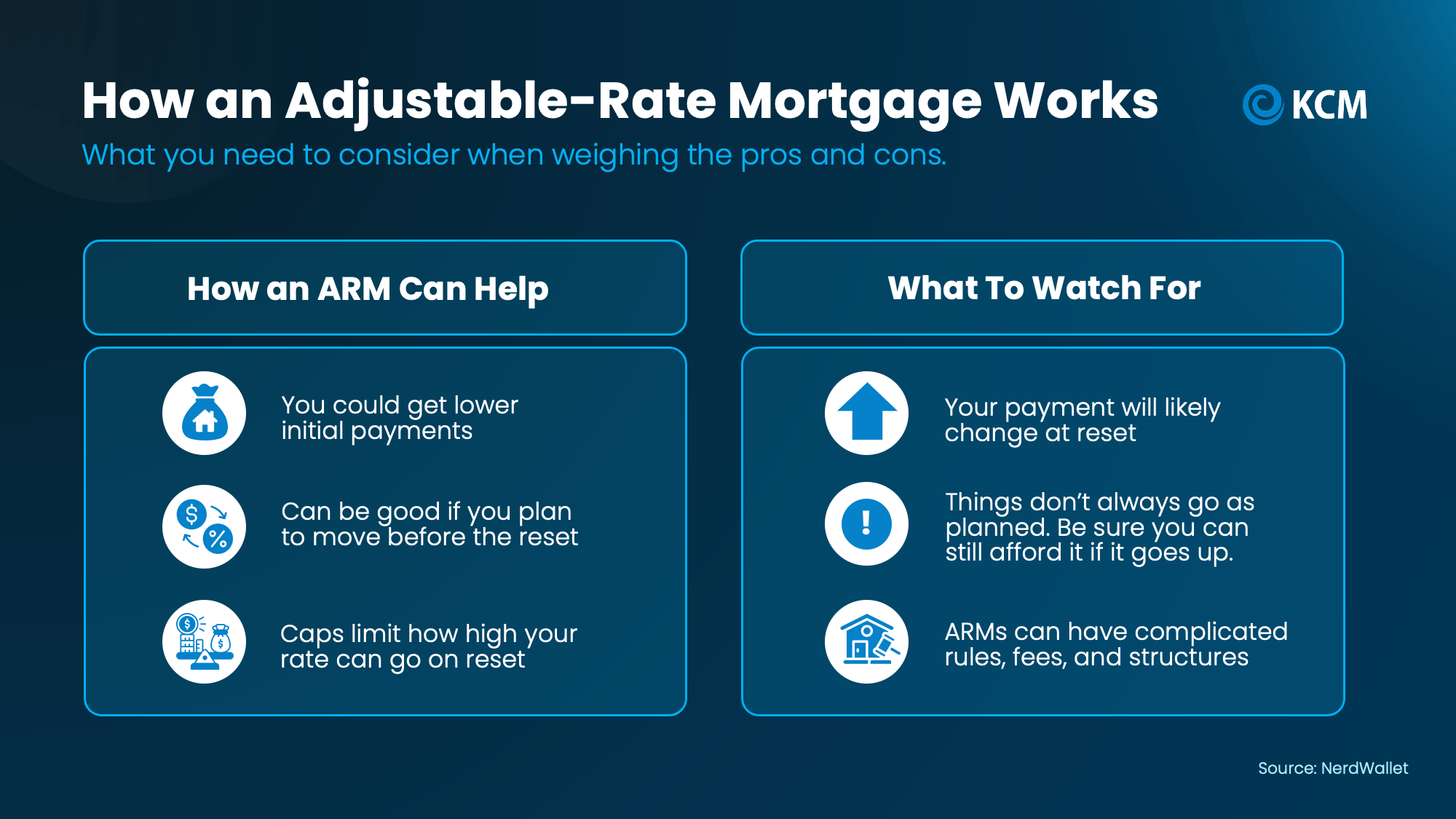
To see if this type of loan may be right for you, here are some things to think about and discuss with your loan officer:

a blue and white rectangular box with white text

Before you decide, ask your lender to work up the numbers and walk you through the different potential scenarios you could run into with an ARM. That way, you go in with your eyes open.

Be Ready for the Reset

And, if you do go with an adjustable-rate mortgage, just know that you’ll have choices when the reset time arrives. You could:

  • Do nothing and keep your loan in place if the new payment still fits your budget.

  • Refinance into a fixed-rate loan with a payment that never changes.

  • Refinance into another ARM with a new lower rate locked for a specified timeframe.

  • Sell your home.

  • Talk to the loan servicer about assistance or modification.

Remember, a refinance is a brand-new loan that you’ll have to qualify for – even if it’s on a home you already own. So, keep tabs on your credit and debt levels and ask your loan officer how major financial moves like job changes and major purchases will affect your mortgage readiness. It’s important to keep your credit and finances in “mortgage shape.”

Today’s ARMs Aren’t Like 2008

One more quick note. ARMs got a bad name after the financial crisis of 2008. Back then, there were some risky loans with small starting payments that later shot way up. Others let people borrow without proving how much money they earned.

But now, there are new laws to protect both borrowers and lenders. The biggest change is the Ability-to-Repay Rule, which says that before a lender makes a home loan, it has to check real paperwork (like pay stubs, W-2 forms, and tax returns) to make sure you can afford it. The lender also has to look at what your payment could be after the reset, not just the low starting payment. 

So, you don’t have to worry that today’s ARMs are the same as the ones we saw back during the crash.

Bottom Line

Today’s market has more options than many people realize. Finding the right one could be as simple as getting more information about tools like ARMs. A trusted lender can run the numbers with you, walk you through the what-ifs, and help you explore the possibilities.

Is an ARM a good option for you? Talk to a loan officer to find out.

Pin It on Pinterest