What Is Multigenerational Housing? [INFOGRAPHIC]

What Is Multigenerational Housing? [INFOGRAPHIC]

What Is Multigenerational Housing? [INFOGRAPHIC] | Simplifying The Market

What Is Multigenerational Housing? [INFOGRAPHIC] | Simplifying The Market

Some Highlights

  • If you have additional loved ones coming to live with you but don’t have enough space, it may be time to consider a larger, multigenerational home.
  • Some key benefits of multigenerational living include a combined homebuying budget, shared caregiving duties, enhanced relationships, and more. These benefits might be why more people are choosing to live in multigenerational homes today.
  • Let’s connect so you can find a house that meets your changing needs and has plenty of space for you and your loved ones.
What You Need To Budget for When Buying a Home

What You Need To Budget for When Buying a Home

What You Need To Budget for When Buying a Home | Simplifying The Market

When it comes to buying a home, it can feel a bit intimidating to know how much you need to save and where to find that information. But you should know, you’re not expected to have all the answers yourself. There are many trusted professionals who can help you understand your finances and what you’ll need to budget for throughout the process.

To get you started, here are a few things experts say you should plan for along the way.

1. Down Payment

As you set your savings goal for your purchase, your down payment is likely already top of mind. And, like many other people, you may believe you need to set aside 20% of the home’s purchase price for that down payment – but that’s not always the case. The National Association of Realtors (NAR) says:

One of the biggest misconceptions among housing consumers is what the typical down payment is and what amount is needed to enter homeownership. Having this knowledge is critical to know what to save . . .”

The good news is, you may be able to put as little as 3.5% (or even 0%) down in some situations. To understand your options, partner with a trusted professional who can go over the various loan types, down payment assistance programs, and what each one requires.

2. Earnest Money Deposit

Another item you may want to plan for is an earnest money deposit. While it isn’t required, it’s common in today’s highly competitive market because it can help your offer stand out in a bidding war.

So, what is it? It’s money you pay as a show of good faith when you make an offer on a house. This deposit works like a credit. You’re using some of the money you already saved for your purchase to show the seller you’re committed and serious about their house. It’s not an added expense, it’s just paying some of that up front. First American explains what it is and how it works:

The deposit made from the buyer to the seller when submitting an offer. This deposit is typically held in trust by a third party and is intended to show the seller you are serious about purchasing their home. Upon closing the money will generally be applied to your down payment or closing costs.”

In other words, an earnest money deposit could be the very first check you’ll write toward your purchase. The amount varies by state and situation. Realtor.com elaborates:

The amount you’ll deposit as earnest money will depend on factors such as policies and limitations in your state, the current market, what your real estate agent recommends, and what the seller requires. On average, however, you can expect to hand over 1% to 2% of the total home purchase price.”

Work with a real estate advisor to understand any requirements in your local area and what they’ve recommended for other buyers in your market. They’ll help you determine if it’s something that could be a useful option for you.

3. Closing Costs

The next thing to plan for is your closing costs. The Federal Trade Commission (FTC) defines closing costs as:

The upfront fees charged in connection with a mortgage loan transaction. …generally including, but not limited to a loan origination fee, title examination and insurance, survey, attorney’s fee, and prepaid items, such as escrow deposits for taxes and insurance.”

Basically, your closing costs cover the fees for various people and services involved in your transaction. NAR has this to say about how much to budget for:

“A home costs more than just the sale price. For example, closing costs—which make up about 2% to 5% of the home’s purchase price—are a major added expense…Lenders provide a Closing Disclosure at least three business days prior to closing on a mortgage. But buyers will need to budget for these added costs ahead of time to avoid sticker shock days before closing.”

The key takeaway is savvy buyers plan ahead for these expenses so they can come into the process prepared. Freddie Mac sums it up like this:

“If you’re in the market to buy a home, your down payment is probably top of mind. And rightly so – it’s likely the biggest cost of homebuying. However, it is not the only cost and it’s critical you understand all your expenses before diving in. The more prepared you are for your down payment, closing and other costs, the smoother your homebuying journey will be.”

Bottom Line

Knowing what to budget for in the homebuying process is essential. To make sure you understand these and any other expenses that may come up, let’s connect so you have reliable expertise on what to expect when you buy a home.


Key Terms for Homebuyers [INFOGRAPHIC]

Key Terms for Homebuyers [INFOGRAPHIC]

Key Terms for Homebuyers [INFOGRAPHIC] | Simplifying The Market

Key Terms for Homebuyers [INFOGRAPHIC] | Simplifying The Market

Some Highlights

  • Knowing key housing terms and how they relate to today’s market is important. For example, when mortgage rates and home prices rise, it impacts how much home you can afford.
  • Terms like appraisal (what lenders rely on to validate a home’s value) and the inspection contingency (which gives buyers essential information on a home’s condition) directly impact the transaction.
  • Buying a home can be intimidating if you’re not familiar with the terms used throughout the process. Let’s connect so you have an expert guide and advice for any questions that may come up.
Key Factors That Impact Affordability Today

Key Factors That Impact Affordability Today

Key Factors That Impact Affordability Today | Simplifying The Market

You can’t read an article about residential real estate without the author mentioning the affordability challenges that today’s buyers face. There’s no doubt homes are less affordable today than they were over the last two years, but that doesn’t mean homes are now unaffordable.

There are three measures used to establish home affordability: home prices, mortgage rates, and wages. Let’s look closely at each of these components.

1. Home Prices

The most recent Home Price Insights report by CoreLogic shows home values have increased by 19.1% from last January to this January. That was one reason affordability declined over the past year.

2. Mortgage Rates

While the current global uncertainty makes it difficult to project mortgage rates, we do know current rates are almost one full percentage point higher than they were last year. According to Freddie Mac, the average monthly rate for last February was 2.81%. This February it was 3.76%. That increase in the mortgage rate also contributes to homes being less affordable than they were last year.

3. Wages

The one big, positive component in the affordability equation is an increase in American wages. In a recent article by RealtyTrac, Peter Miller addresses that point:

“Prices are up, but what about wages? ADP reports that job holder incomes increased 5.9% last year but rose 8.0% for those who switched employers. In effect, some of the higher cost to buy a home has been offset by more cash income.”

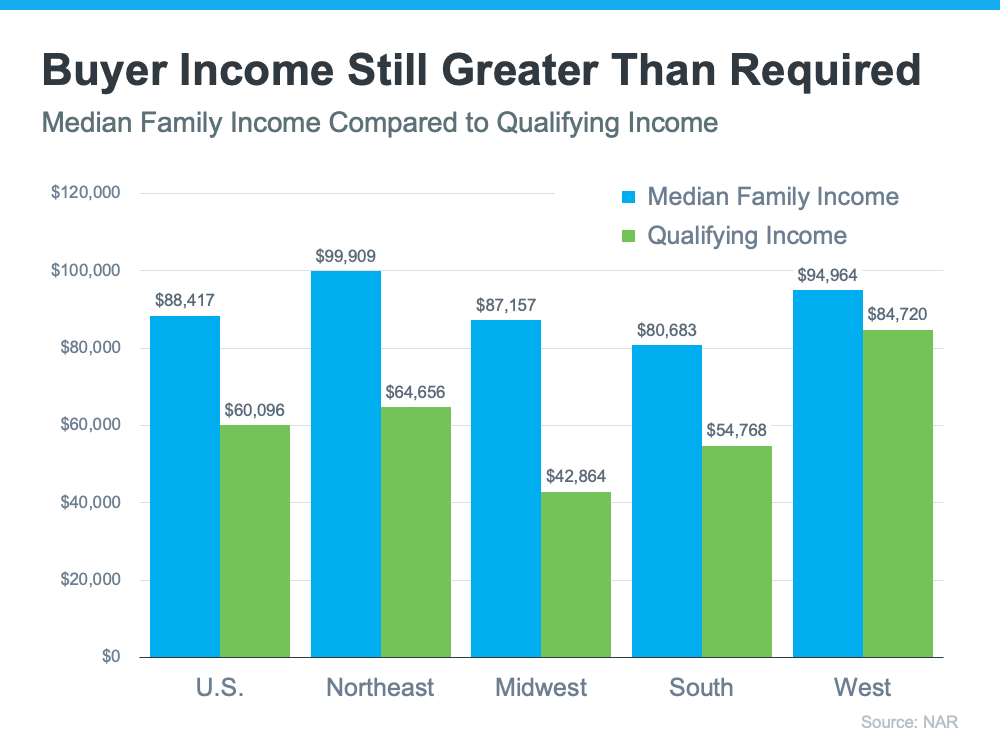
The National Association of Realtors (NAR) also recently released information that looks at income and affordability. The NAR data provides a comparison of the current median family income versus the qualifying income for a median-priced home in each region of the country. Here’s a graph of their findings:

Key Factors That Impact Affordability Today | Simplifying The Market

As the graph shows, the median family income (shown in blue on the graph) is greater than the qualifying income needed to buy a median-priced home (shown in green on the graph) in all four regions of the country. While those figures may vary in certain locations within each region, it’s important to note that, in most of the country, homes are still affordable.

So, when you think about affordability, remember that the picture includes more than just home prices and mortgage rates. When prices rise and rates rise, it does impact affordability, and experts project both of those things will climb in the months ahead. That’s why it’s less affordable to buy a home than it was over the past two years when prices and rates were lower than they are today. But wages need to be factored into affordability as well. Because wages have been rising, they’re a big reason that, while less affordable, homes are not unaffordable today.

Bottom Line

To find out more about affordability in our local area, let’s discuss where home prices are locally, what’s happening with mortgage rates, and get you in contact with a lender so you can make an informed financial decision. Remember, while less affordable, homes are not unaffordable, which still gives you an opportunity to buy today.

Down Payment Assistance Programs Can Help You Achieve Homeownership

Down Payment Assistance Programs Can Help You Achieve Homeownership

Down Payment Assistance Programs Can Help You Achieve Homeownership | Simplifying The Market

For many homebuyers, the thought of saving for a down payment can feel daunting, especially in today’s market. That’s why, when asked what they find most difficult in the homebuying process, some buyers say it’s one of the hardest steps on the path to homeownership. Data from the National Association of Realtors (NAR) shows:

“For first-time home buyers, 29 percent said saving for a downpayment [sic] was the most difficult step in the process.

If you’re finding that your down payment is your biggest hurdle, the good news is there are many down payment assistance programs available that can help you achieve your goals. The key is understanding where to look and learning what options are available. Here’s some information that can help.

First-Time and Repeat Buyers Are Often Eligible

According to downpaymentresource.com, there are thousands of financial assistance programs available for homebuyers, like affordable mortgage options for first-time buyers. But, of the many programs that are available, down payment assistance options make up the large majority. They say 73% of the assistance available to homebuyers is there to help you with your down payment.

And it’s not just first-time homebuyers that are eligible for these programs. Downpaymentresource.com notes:

“You don’t have to be a first-time buyer. Over 38% of all programs are for repeat homebuyers who have owned a home in the last 3 years.”

That means no matter where you are in your homeownership journey, there could be an option available for you.

There Are Local Programs and Specialized Programs for Public Servants

There are also multiple down payment assistance resources designed to help those who serve our communities. Teacher Next Door is one of those programs:

“The Teacher Next Door Program was designed to increase home ownership among teachers and other public servants, support community development and increase access to affordable housing free from discrimination.”

Teacher Next Door is just one program that seeks to help teachers, first responders, health providers, government employees, active-duty military personnel, and veterans reach their down payment goals.

And, most importantly, even if you don’t qualify for these types of specialized programs, there are many federal, state, and local programs available for you to explore. And the best way to do that is to connect with a local real estate professional to learn more about what’s available in your area.

Bottom Line

If saving for a down payment seems daunting, there are programs available that can help. And if you work to serve our community, there may be even more opportunities available to you. To learn more about your options, let’s connect so you can start your homebuying journey today.

Don’t Let Student Loans Delay Your Homeownership Dreams

Don’t Let Student Loans Delay Your Homeownership Dreams

Don’t Let Student Loans Delay Your Homeownership Dreams | Simplifying The Market

If you’re looking to buy a home, you may be wondering how your student loan debt could impact those plans. Do you have to wait until you’ve paid off your student loans before you can buy your first home? Or could you qualify for a home loan with that debt?

To give you the answers you’re searching for, let’s take a look at what recent data shows. That way, you know what to expect and what to do next to achieve your dream of becoming a homeowner. While everyone’s situation is unique, your goal may be more within your reach than you realize.

Do you have to delay your plans because of student loans?

If you’re worried your student loans mean you have to put your homeownership goals on hold, you’re not alone. In fact, many first-time buyers believe they have to delay their plans. According to data from the National Association of Realtors (NAR):

When asked specifically about purchasing a home, half of nonhomeowners say student loan debt is delaying them from purchasing a home (51%).”

When asked why their student loans are putting their plans on the back burner, three key themes emerged:

  • 47% say their student loans make it harder to save for a down payment
  • 45% say they think they can’t qualify for a home loan because of existing debt
  • 43% say they believe the delay is necessary even though they’ve never applied for a mortgage

No matter which reason resonates most with you, you should know a delay may not be necessary. Here’s why.

Can you qualify for a home loan if you have student loans?

In the same NAR report, data shows many current homeowners have student loan debt themselves:

“Nearly one-quarter of all home buyers, and 37% of first-time buyers, had student debt, with a typical amount of $30,000.”

That means other people in a similar situation were able to qualify for and buy a home even though they also had student loan debt. You may be able to do the same, especially if you have a steady source of income. Apartment Therapy drives this point home:

“. . . buying a home with student loans is possible, experts say. The proof is in the numbers, too: Some 40 percent of first-time homebuyers have student loan debt, according to the NAR study.”

The key takeaway is, for many people, homeownership is achievable even with student loans. 

The best way to make a decision about your goals and next steps is to talk to the professionals. A real estate advisor can walk you through your specific situation, your options, and what has worked for other buyers like you. They can also connect you with other professionals in the industry who can help. You don’t have to figure this out on your own – lean on the experts so you have the information you need to make an informed, confident decision.

Bottom Line

Many other buyers with student loan debt are already achieving their homeownership dreams. Maybe it’s time to take the next step toward making yours a reality. Let’s connect to discuss your options and find out how close you are to achieving your goal.

Pin It on Pinterest