Real Estate Voted the Best Investment Eight Years in a Row

Real Estate Voted the Best Investment Eight Years in a Row

Real Estate Voted the Best Investment Eight Years in a Row | Simplifying The Market

In an annual Gallup poll, Americans chose real estate as the best long-term investment. And it’s not the first time it’s topped the list, either. Real estate has been on a winning streak for the past eight years, consistently gaining traction as the best long-term investment (see graph below):

Real Estate Voted the Best Investment Eight Years in a Row | Simplifying The MarketIf you’re thinking about purchasing a home this year, this poll should reassure you. Even when inflation is rising like it is today, Americans agree an investment like real estate truly shines.

Why Is Real Estate a Great Investment During Times of High Inflation?

With inflation reaching its highest level in 40 years, it’s more important than ever to understand the financial benefits of homeownership. Rising inflation means prices are increasing across the board. That includes goods, services, housing costs, and more. But when you purchase your home, you lock in your monthly housing payments, effectively shielding yourself from increasing housing payments. James Royal, Senior Wealth Management Reporter at Bankrate, explains it like this:

A fixed-rate mortgage allows you to maintain the biggest portion of housing expenses at the same payment. Sure, property taxes will rise and other expenses may creep up, but your monthly housing payment remains the same.”

If you’re a renter, you don’t have that same benefit, and you aren’t protected from increases in your housing costs, especially rising rents.

History Shows During Inflationary Periods, Home Prices Rise as Well

As a homeowner, your house is an asset that typically increases in value over time, even during inflation. That‘s because, as prices rise, the value of your home does, too. And that makes buying a home a great hedge during periods of high inflation. Natalie Campisi, Advisor Staff for Forbes, notes:

Tangible assets like real estate get more valuable over time, which makes buying a home a good way to spend your money during inflationary times.

Bottom Line

Housing truly is a strong investment, especially when inflation is high. When you lock in a mortgage payment, you’re shielded from housing cost increases, and you own an asset that typically gains value with time. If you want to better understand how buying a home could be a great investment for you, let’s connect today.

Are You Ready To Fall in Love with Homeownership?

Are You Ready To Fall in Love with Homeownership?

Are You Ready To Fall in Love with Homeownership? | Simplifying The Market

Financial benefits are always a key aspect of homeownership, but it’s also important to understand that the nonfinancial and personal benefits are why so many people genuinely fall in love with their homes. When you own your home, you likely feel a sense of emotional attachment because of the comfort it provides, but also because it’s a space that’s truly yours.

Over the past two years, we’ve learned to love our homes even more as we’ve stayed home more than ever due to the ongoing pandemic. As a result, the personal and emotional benefits our homes provide have become even more important to us.

As the most recent State of the American Homeowner from Unison puts it:

“Despite the upheaval and uncertainty of the past year, one thing has stayed the same: the home continues to be of the utmost importance and a place of security and comfort.

When the health crisis began, the world around us changed almost overnight, and our homes were redefined. Our needs shifted, and our shelters became a place that protected us on a whole new level. The same study from Unison notes:

  • 91% of homeowners say they feel secure, stable, or successful owning a home
  • 64% of American homeowners say living through a pandemic has made their home more important to them than ever
  • 83% of homeowners say their home has kept them safe during the COVID-19 pandemic

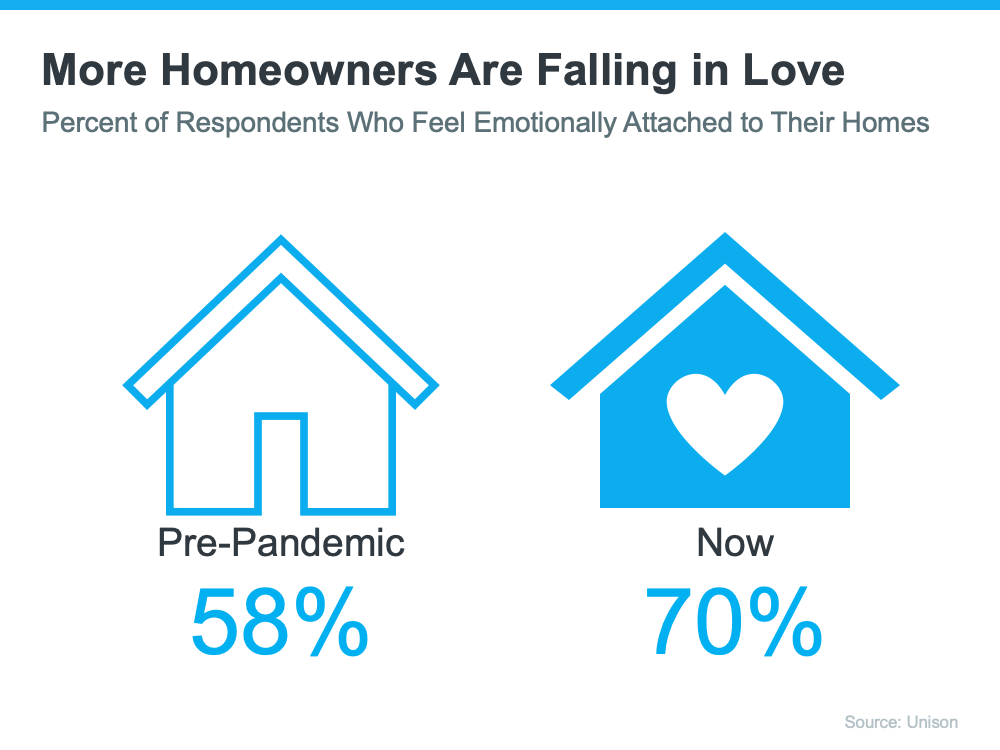
It’s no surprise this study also reveals that homeowners now love their homes even more as our emotional attachments to them have grown:

Are You Ready To Fall in Love with Homeownership? | Simplifying The Market

That sense of emotional connection genuinely reaches far beyond the financial aspect of homeownership. Because they’re our shelters – ones that we can genuinely call our own. Our homes touch our hearts and can also positively impact our mental health.

As JD Esajian, President of CT Homes, LLC, says:

“Aside from the financial factors, there are several social benefits of homeownership and stable housing to consider. It has long been thought that buying a home contributes to a sense of accomplishment. Still, most individuals fail to realize that homeownership can benefit your mental health and the community around you.

Whether you’re thinking of buying your first home, moving up to your dream home, or downsizing to something that better fits your changing lifestyle, take a moment to reflect on what Mark Fleming, Chief Economist at First American, notes:

“Buying a home is not just a financial decision. It’s also a lifestyle decision.

Bottom Line

There are so many reasons to fall head over heels for homeownership. Your home will provide a place to customize and call your own, in addition to stability and security. If you’re ready to fall in love with homeownership, let’s connect so you can get started on your homebuying journey today.


How To Win as a Buyer in a Sellers’ Market [INFOGRAPHIC]

How To Win as a Buyer in a Sellers’ Market [INFOGRAPHIC]

How To Win as a Buyer in a Sellers’ Market [INFOGRAPHIC] | Simplifying The Market

How To Win as a Buyer in a Sellers’ Market [INFOGRAPHIC] | Simplifying The Market

Some Highlights

  • Even in today’s sellers’ market, there are still ways for buyers to win big.
  • Build a team of trusted professionals and make strategic plays as you budget and pick your desired neighborhoods. Then, be ready for the competition by getting a pre-approval letter and leaning on your expert advisors to draft a winning offer.
  • In a sellers’ market, you can still be the champion if you have the right team and strategy. Let’s connect today to make your game-winning play.
The Path To Homeownership Can Be Steeper for Some Americans

The Path To Homeownership Can Be Steeper for Some Americans

The Path To Homeownership Can Be Steeper for Some Americans | Simplifying The Market

As we celebrate Black History Month, we honor and recognize the past and present experiences of Black Americans. A significant part of this experience is investing in a home of their own. While equitable access to housing has come a long way, the path to homeownership is still steeper for households of color. It’s an important experience to talk about, along with how working with the right real estate experts can make all the difference for diverse homebuyers.

We know it’s a more challenging journey to achieve homeownership for some because there’s still a measurable gap between the overall average U.S. homeownership rate and that of non-white groups. Today, the lowest homeownership rate persists in the Black community (see graph below):

The Path To Homeownership Can Be Steeper for Some Americans | Simplifying The Market

Homeownership is an essential piece for building household wealth that can be passed down to future generations. However, there are obstacles in the homebuying process that can negatively impact certain racial and ethnic groups, including the Black community. This can delay or prevent many from achieving homeownership, challenging their ability to grow their net worth. A report by Vanessa G. Perry of the George Washington University School of Business and Janneke Ratcliffe of the Urban Institute explains:

“. . . households of color have much lower homeownership rates than white households and consequently hold, at the median, just one-eighth the wealth of white households.”

On top of that, when Black households do become homeowners, research shows they pay more for those homes overall than the average household. Raheem Hanifa, a Research Analyst for the Joint Center for Housing Studies of Harvard University, tells us:

“Black homeowners not only have primary mortgages with higher interest rates than white homeowners with similar incomes, they also have higher interest rates than white homeowners with substantially lower incomes, . . . Black homeowners have experienced systemic barriers to homeownership and wealth-building opportunities that have limited their ability to access credit, which is a key component in receiving low mortgage interest rates.”

For Black homebuyers, the inequity that remains in housing can be a point of pain and frustration. That’s why it’s so important for members of diverse groups to have the right team of experts on their sides throughout the homebuying process. These professionals aren’t only experienced advisors who understand the market and give the best advice. They’re also compassionate allies who will advocate for your best interests every step of the way.

Bottom Line

Opportunities in real estate improve every day, but there are still equity challenges that many face. Let’s connect to make sure you have an advocate on your side as you walk the path to homeownership.

Don’t Let Student Loans Delay Your Homeownership Dreams

Don’t Let Student Loans Delay Your Homeownership Dreams

Don’t Let Student Loans Delay Your Homeownership Dreams | Simplifying The Market

If you’re looking to buy a home, you may be wondering how your student loan debt could impact those plans. Do you have to wait until you’ve paid off your student loans before you can buy your first home? Or could you qualify for a home loan with that debt?

To give you the answers you’re searching for, let’s take a look at what recent data shows. That way, you know what to expect and what to do next to achieve your dream of becoming a homeowner. While everyone’s situation is unique, your goal may be more within your reach than you realize.

Do you have to delay your plans because of student loans?

If you’re worried your student loans mean you have to put your homeownership goals on hold, you’re not alone. In fact, many first-time buyers believe they have to delay their plans. According to data from the National Association of Realtors (NAR):

When asked specifically about purchasing a home, half of nonhomeowners say student loan debt is delaying them from purchasing a home (51%).”

When asked why their student loans are putting their plans on the back burner, three key themes emerged:

  • 47% say their student loans make it harder to save for a down payment
  • 45% say they think they can’t qualify for a home loan because of existing debt
  • 43% say they believe the delay is necessary even though they’ve never applied for a mortgage

No matter which reason resonates most with you, you should know a delay may not be necessary. Here’s why.

Can you qualify for a home loan if you have student loans?

In the same NAR report, data shows many current homeowners have student loan debt themselves:

“Nearly one-quarter of all home buyers, and 37% of first-time buyers, had student debt, with a typical amount of $30,000.”

That means other people in a similar situation were able to qualify for and buy a home even though they also had student loan debt. You may be able to do the same, especially if you have a steady source of income. Apartment Therapy drives this point home:

“. . . buying a home with student loans is possible, experts say. The proof is in the numbers, too: Some 40 percent of first-time homebuyers have student loan debt, according to the NAR study.”

The key takeaway is, for many people, homeownership is achievable even with student loans. 

The best way to make a decision about your goals and next steps is to talk to the professionals. A real estate advisor can walk you through your specific situation, your options, and what has worked for other buyers like you. They can also connect you with other professionals in the industry who can help. You don’t have to figure this out on your own – lean on the experts so you have the information you need to make an informed, confident decision.

Bottom Line

Many other buyers with student loan debt are already achieving their homeownership dreams. Maybe it’s time to take the next step toward making yours a reality. Let’s connect to discuss your options and find out how close you are to achieving your goal.

The Top Indicator if You Want To Know Where Mortgage Rates Are Heading

The Top Indicator if You Want To Know Where Mortgage Rates Are Heading

The Top Indicator if You Want To Know Where Mortgage Rates Are Heading | Simplifying The Market

Mortgage rates have increased significantly since the beginning of the year. Each Thursday, Freddie Mac releases its Primary Mortgage Market Survey. According to the latest survey, the average 30-year fixed-rate mortgage has risen from 3.22% at the start of the year to 3.55% as of last week. This is important to note because any increase in mortgage rates changes what a purchaser can afford. To give you an idea of how rising mortgage rates impact your purchasing power, see the table below:

The Top Indicator if You Want To Know Where Mortgage Rates Are Heading | Simplifying The Market

How Can You Know Where Mortgage Rates Are Headed?

While it’s always difficult to know exactly where mortgage rates will go, a great indicator of where they may head is by looking at the 50-year history of the 10-year treasury yield, and then following its path. Understanding the mechanics of the treasury yield isn’t as important as knowing that there’s a correlation between how it moves and how mortgage rates follow. Here’s a graph showing that relationship over the last 50 years:

The Top Indicator if You Want To Know Where Mortgage Rates Are Heading | Simplifying The Market

This correlation has continued into the new year. The treasury yield has started to climb, and that’s driven rates up. As of last Thursday, the treasury yield was 1.81%. That’s 1.74% below the mortgage rate reported the same day (3.55%) and is very close to the average spread we see between the two numbers (average spread is 1.7).

Where Will the Treasury Yield Head in the Future?

With this information in mind, a 10-year treasury-yield forecast would be a good indicator of where mortgage rates may be headed. The Wall Street Journal just surveyed a panel of over 75 academic, business, and financial economists asking them to forecast the treasury yield over the next few years. The consensus was that experts project the treasury yield will climb to 2.84% by the end of 2024. Based on the 50-year history of following this yield, that would likely put mortgage rates at about 4.5% in three years.

While the correlation between the 30-year fixed mortgage rate and the 10-year treasury yield is clear in the data shown above for the past 50 years, it shouldn’t be used as an exact indicator. They’re both hard to forecast, especially in this unprecedented economic time driven by a global pandemic. Yet understanding the relationship can help you get an idea of where rates may be going. It appears, based on the information we have now, that mortgage rates will continue to rise over the next few years. If that’s the case, your best bet may be to purchase a home sooner rather than later, if you’re able.

Bottom Line

Forecasting mortgage rates is very difficult. As Mark Fleming, Chief Economist at First American, once said:

“You know, the fallacy of economic forecasting is don’t ever try and forecast interest rates and or, more specifically, if you’re a real estate economist mortgage rates, because you will always invariably be wrong.”

However, if you’re either a first-time homebuyer or a current homeowner thinking of moving into a home that better fits your changing needs, understanding what’s happening with the 10-year treasury yield and mortgage rates can help you make an informed decision on the timing of your purchase.

Pin It on Pinterest