If you’ve been in your home for longer than five years, you’re not alone. According to recent data from First American, homeowners are staying put much longer than historical averages (see graph below):As the graph shows, before 2008, homeowners sold their houses after an average of just five years. Today, that number has more than doubled to over 10 years. The housing industry refers to this as your tenure.
To really explore tenure, it’s important to understand what drives people to make a move. An article from The Balance explores some of the primary reasons individuals choose to sell their houses. It says:
“People who move for home-related reasons might need a larger home or a house that better fits their needs, . . . Financial reasons for moving include wanting a nicer home, moving to a newer home to avoid making repairs on the old one, or cashing in on existing equity.”
If you’ve been in your home for longer than the norm, chances are you’re putting off addressing one, if not several, of the reasons other individuals choose to move. If this sounds like you, here are a few things to consider:
If your needs have changed, it may be time to re-evaluate your home.
As the past year has shown, our needs can change rapidly. That means the longer you’ve been in your home, the more likely it is your needs have evolved. The Balance notes several personal factors that could lead to your home no longer meeting your needs, including relationship and job changes.
For example, many workers recently found out they’ll be working remotely indefinitely. If that’s the case for you, you may need more space for a dedicated home office. Other homeowners choose to sell because the number of people living under their roof changes. Now more than ever, we’re spending more and more time at home. As you do, consider if your home really delivers on what you need moving forward.
It’s often financially beneficial to sell your house and move.
One of the biggest benefits of homeownership is the equity your home builds over time. If you’ve been in your house for several years, you may not realize how much equity you have. According to the latest Homeowner Equity Report from CoreLogic, homeowners gained an average of $33,400 in equity over the past year.
That equity, plus today’s low mortgage rates, can fuel a major upgrade when you sell your home and purchase a new one. Or, if you’re looking to downsize, your equity can help provide a larger down payment and lower your monthly payments over the life of your next loan. No matter what, there are significant financial benefits to selling in today’s market.
Bottom Line
If you’ve been in your home for 5-10 years or more, now might be the time to explore your options. Today’s low rates and your built-up equity could provide you with the opportunity to address your evolving needs. If you feel it’s time to sell, let’s connect.
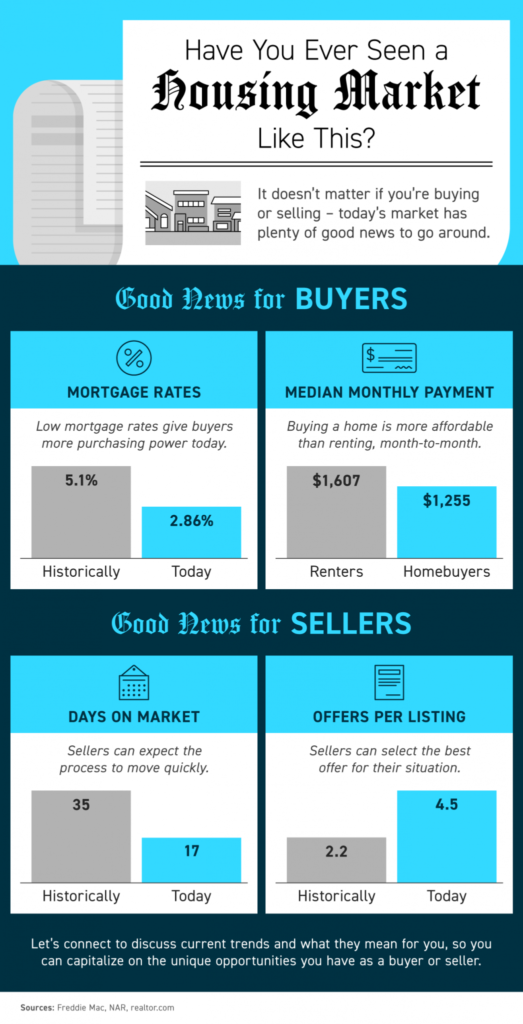
Whether you’re buying or selling – today’s housing market has plenty of good news to go around.
Buyers can take advantage of today’s mortgage rates to escape rising rents and keep monthly payments affordable. Sellers can reap the benefits of multiple offers and a fast sale.
If this sounds like good news to you, let’s connect today so you can capitalize on the unique opportunity you have in today’s market.
In today’s sellers’ market, standing out as a buyer is critical. Multi-offer scenarios and bidding wars are the norm due to the low supply of houses for sale and high buyer demand. If you’re buying this fall, you’ll want every advantage, especially when you’ve found the home of your dreams.
Below are five things to keep in mind when it’s time to make an offer.
1. Know Your Budget
Knowing your budget and what you can afford is critical to your success as a homebuyer. The best way to understand your numbers is to work with a lender so you can get pre-approved for a loan. As Freddie Macputs it:
“This pre-approval allows you to look for a home with greater confidence and demonstrates to the seller that you are a serious buyer.”
Showing sellers you’re serious can give you a competitive edge. It enables you to act quickly when you’ve found your perfect home.
2. Be Prepared To Move Fast
Speed and the pace of sales are contributing factors to today’s competitive housing market. According to the latest Existing Home Sales Report from the National Association of Realtors (NAR), the average home is on the market for just 17 days. As the report notes:
“Eighty-nine percent of homes sold in July 2021 were on the market for less than a month.”
When homes are selling fast, staying on top of the market and moving quickly are key. After you’ve worked with your agent to find the home that suits your needs, they’ll help you put together and submit your best offer as soon as possible.
3. A Real Estate Professional Can Lead You to Victory
No matter what the housing market looks like, rely on a trusted real estate advisor. As Freddie Macsays:
“The success of your homebuying journey largely depends on the company you keep. . . . be sure to select experienced, trusted professionals who will help you make informed decisions and avoid any pitfalls.”
Agents are experts in the local real estate market. They have insight into what’s worked for other buyers in your area and what sellers may be looking for in an offer. It may seem simple, but catering to what a seller may need can help your offer stand out.
4. Craft a Strong, Fair Offer
In the past, offering at or near the asking price was enough to make your offer appealing to sellers. In today’s market, that’s often not the case. According to the latest Realtors Confidence Index from NAR, 50% of offers are above the list price.
In such a competitive market, emotions and prices can run high. Having an agent to help craft a strong, fair offer is critical in these situations. Your agent can help you understand:
The market value of the home
Recent sales trends in the area
Current buyer demand
5. Understand the Seller’s Needs, but Resist Waiving Certain Contingencies
When crafting an offer, you’ll want to keep both your best interest and the interest of the seller in mind. Your trusted real estate advisor will help you consider which levers you could pull, including contract contingencies (conditions you set that the seller must meet for the purchase to be finalized). Of course, there are certain contingencies you don’t want to give up, like the home inspection.
“Resist the temptation to waive the inspection contingency, especially in a hot market or if the home is being sold ‘as-is’, which means the seller won’t pay for repairs. Without an inspection contingency, you could be stuck with a contract on a house you can’t afford to fix.”
Bottom Line
Today’s competitive housing market makes it more important than ever to make a strong offer on a home. Let’s connect to make sure your offer rises to the top.
An important metric in today’s residential real estate market is the number of homes available for sale. The shortage of available housing inventory is the major reason for the double-digit price appreciation we’ve seen in each of the last two years. It’s the reason many would-be purchasers are frustrated with the bidding wars over the homes that are available. However, signs of relief are finally appearing.
According to data from realtor.com, active listings have increased over the last four months. They define active listings as:
“The active listing count tracks the number of for sale properties on the market, excluding pending listings where a pending status is available. This is a snapshot measure of how many active listings can be expected on any given day of the specified month.”
What normally happens throughout the year?
Historically, housing inventory increases throughout the summer months, starts to tail off in the fall, and then drops significantly over the winter. The graph below shows this trend along with the month active listings peaked in 2017, 2018, and 2019.
What happened last year?
Last year, the trend was different. Historical seasonality wasn’t repeated in 2020 since many homeowners held off on putting their houses up for sale because of the pandemic (see graph below). In 2020, active listings peaked in April, and then fell off dramatically for the remainder of the year.
What’s happening this year?
Due to the decline of active listings in 2020, 2021 began with record-low housing inventory counts. However, we’ve been building inventory over the last several months as more listings come to the market (see graph below):There are three main reasons we may see listings continue to increase throughout this fall and into the winter.
Pent-up selling demand – Homeowners may be more comfortable putting their homes on the market as more and more Americans get vaccinated.
New construction is starting to take off – Though new construction is not included in the realtor.com numbers, as more new homes are built, there will be more options for current homeowners to consider when they sell. The lack of options has slowed many potential sellers in the past.
The end of forbearance will create some new listings – Most experts believe the end of the forbearance program will not lead to a wave of foreclosures for several reasons. The main reason is the level of equity homeowners currently have in their homes. Many homeowners will be able to sell their homes instead of going to foreclosure, which will lead to some additional listings on the market.
Bottom Line
If you’re in the market to buy a home, stick with it. There are new listings becoming available every day. If you’re thinking of selling your house, you may want to list your home before this additional competition comes to market.
When it comes to the current housing market, there are multiple misconceptions – from what the current supply of available homes looks like to how much houses are selling for.
It takes professionals who study expert opinions and data to truly understand the real estate market and separate fact from fiction.
Trust the pros. If you want to understand why it’s still a good time to buy, let’s connect today.
Exterior view of custom built home with exterior lighting and manicured landscaping.
One of the major story lines over the last year is how well the residential real estate market performed. One key metric in the spotlight is home price appreciation. According to the latest indices, home prices are skyrocketing this year.
Here are the latest percentages showing the year-over-year increase in home price appreciation:
The dramatic increases are seen at every price point and in all regions of the country.
Increases Are Across Every Price Point
According to the latest Home Price Index from CoreLogic, each price range is seeing at least a 19% increase year-over-year:
Increases Are Across Every Region in the Country
Every region in the country is experiencing at least a 14.9% increase in home price appreciation, according to the Federal Housing Finance Agency (FHFA):
Increases Are Across Each of the Top 20 Metros in the Country
According to the U.S. National Home Price Index from S&P Case-Shiller, every major metro is seeing at least a 13.3% growth in prices (see graph below):
What About Price Appreciation in 2022?
Prices are the result of the balance between supply and demand. The demand for single-family homes has been strong over the last 18 months. The supply of houses available for sale was near historic lows. However, there’s some good news on the supply side. Realtor.comreports:
“432,000 new listings hit the national housing market in August, an increase of 18,000 over last year.”
There will, however, still be a shortage of supply compared to demand in 2022. CoreLogicreveals:
“Given the widespread demand and considering the number of standalone homes built during the past decade, the single-family market is estimated to be undersupplied by 4.35 million units by 2022.”
Yet, most forecasts call for home price appreciation to moderate in 2022. The Home Price Expectation Survey, a survey of over 100 economists, investment strategists, and housing market analysts, calls for a 5.12% appreciation level next year. Here are the 2022 home appreciation forecasts from the four other major entities:
Price appreciation is expected to slow in 2022 when compared to the record highs of 2021. However, it is still expected to be greater than the annual average of 4.1% over the last 25 years.
Bottom Line
If you owned a home over the past year, you’ve seen your household wealth grow substantially, and you’ll see another nice boost in 2022. If you’re thinking of buying, consider buying now as prices are forecast to continue increasing through at least next year.




![Have You Ever Seen a Housing Market Like This? [INFOGRAPHIC]](https://housingcoach.com/wp-content/uploads/2021/10/image-3-1046x675.png)



![Fact or Fiction: Homebuyer Edition [INFOGRAPHIC]](https://housingcoach.com/wp-content/uploads/2021/10/image-2-1046x675.png)