The One Thing Every Homeowner Needs To Know About a Recession

The One Thing Every Homeowner Needs To Know About a Recession
The One Thing Every Homeowner Needs To Know About a Recession | Simplifying The Market

A recession does not equal a housing crisis. That’s the one thing that every homeowner today needs to know. Everywhere you look, experts are warning we could be heading toward a recession, and if true, an economic slowdown doesn’t mean homes will lose value.

The National Bureau of Economic Research (NBER) defines a recession this way:

“A recession is a significant decline in economic activity spread across the economy, normally visible in production, employment, and other indicators. A recession begins when the economy reaches a peak of economic activity and ends when the economy reaches its trough. Between trough and peak, the economy is in an expansion.”

To help show that home prices don’t fall every time there’s a recession, take a look at the historical data. There have been six recessions in this country over the past four decades. As the graph below shows, looking at the recessions going all the way back to the 1980s, home prices appreciated four times and depreciated only two times. So, historically, there’s proof that when the economy slows down, it doesn’t mean home values will fall or depreciate.

The One Thing Every Homeowner Needs To Know About a Recession | Simplifying The Market

The first occasion on the graph when home values depreciated was in the early 1990s when home prices dropped by less than 2%. It happened again during the housing crisis in 2008 when home values declined by almost 20%. Most people vividly remember the housing crisis in 2008 and think if we were to fall into a recession that we’d repeat what happened then. But this housing market isn’t a bubble that’s about to burst. The fundamentals are very different today than they were in 2008. So, we shouldn’t assume we’re heading down the same path.

Bottom Line

We’re not in a recession in this country, but if one is coming, it doesn’t mean homes will lose value. History proves a recession doesn’t equal a housing crisis.


How Homeownership Can Bring You Joy

How Homeownership Can Bring You Joy

How Homeownership Can Bring You Joy | Simplifying The Market

If you’re trying to decide whether to rent or buy a home, you’re probably weighing a few different factors. The financial benefits of homeownership might be one of the reasons you want to make a purchase if you’re a renter, but the decision can also be motivated by having a place that’s uniquely your own.

If you want to express yourself by upgrading and customizing your living space but are feeling held back by your rental agreement, it might be time to consider the perks of owning your home.

A Little Change Can Bring Lots of Joy

There’s a significant level of pride that comes from owning a home. That’s because it’s a space that truly belongs to you.

A recent report from the National Association of Realtors (NAR) shows making updates or remodeling your home can help you feel more at ease and comfortable in your living space. NAR measures this with a Joy Score that indicates how much happiness specific home upgrades bring. According to NAR:

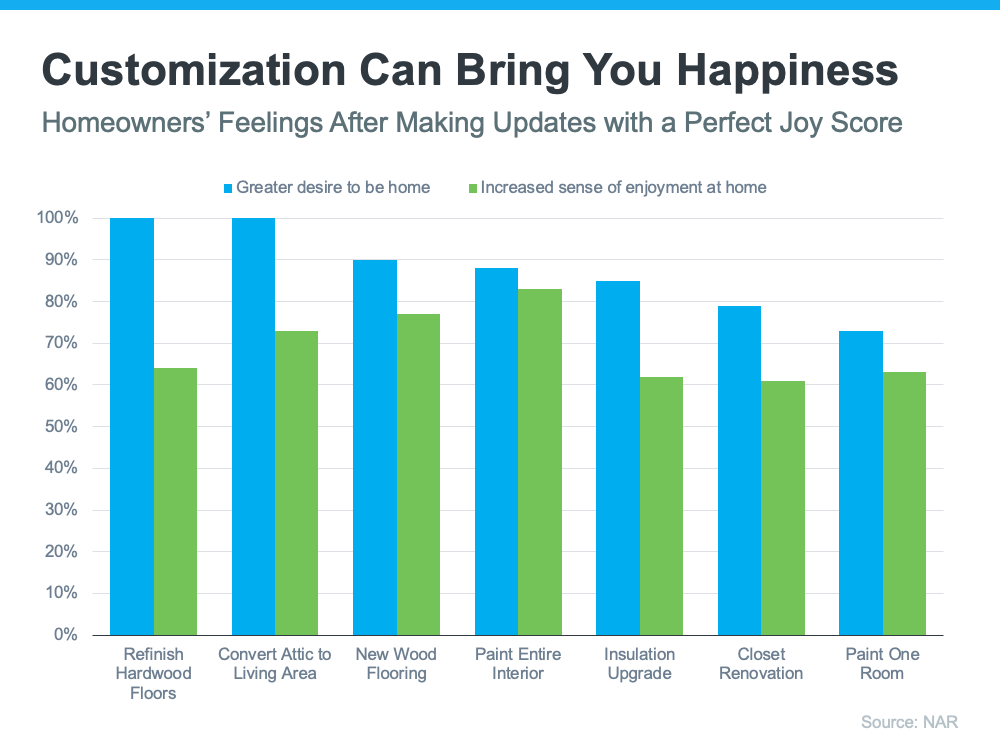
There were numerous interior projects that received a perfect Joy Score of 10: paint entire interior of home, paint one room of home, add a new home office, hardwood flooring refinish, new wood flooring, closet renovation, insulation upgrade, and attic conversion to living area.

The report also breaks down just how much each of these projects can enhance your emotional attachment to your home, even leading you to want to spend even more time in the space (see graph below):

How Homeownership Can Bring You Joy | Simplifying The Market

And while many of the items NAR highlights are larger tasks, some, like painting rooms, are much smaller. Even those quicker projects can still bring you a greater sense of joy and accomplishment. Not to mention when you make upgrades in your home, you could be increasing its value which also gives your net worth a boost if you invest your time and effort wisely.

You’re Free To Update Your Home to Your Heart’s Content

These types of updates can result in additional happiness when you complete them, but there’s another reason you can feel good as a homeowner. In most situations, you’re free to renovate or update the interior of your home without needing additional permission. But as Business Insider points out, renters may not have the same freedom:

“Your landlord won’t always approve changes when you rent. But you have the power to update the home when you’re the owner. (Just make sure any big changes are approved by your homeowner’s association, if necessary.)”

If you do make changes as a renter, there’s a good chance you’ll need to revert them back at the end of your lease based on your rental agreement. That can add additional costs when you move out. That’s one major benefit of owning your own home. Unless there are specific homeowner’s association requirements, you typically won’t have to worry about the changes you can and can’t make.

Bottom Line

Deciding whether to rent or buy is a personal decision. The financial benefits are critical, but don’t overlook the emotional impact homeownership can have. Let’s connect to discuss all the benefits you can enjoy when you purchase your own home.

Why Rising Mortgage Rates Push Buyers off the Fence

Why Rising Mortgage Rates Push Buyers off the Fence

Why Rising Mortgage Rates Push Buyers off the Fence | Simplifying The Market

If you’re thinking about buying a home, you’ve probably heard mortgage rates are rising and have wondered what that means for you. Since mortgage rates have increased over two percentage points this year, it’s natural to think about how this will impact your homeownership plans.

Today, buyers are reacting in one of two ways: they’re either making the decision to buy now before rates climb higher or they’re waiting it out in hopes rates will fall. Let’s look at some context that can help you understand why so many buyers are jumping off the fence and into action rather than waiting to buy.

A Look Back: How the Current Mortgage Rate Compares to Historical Data

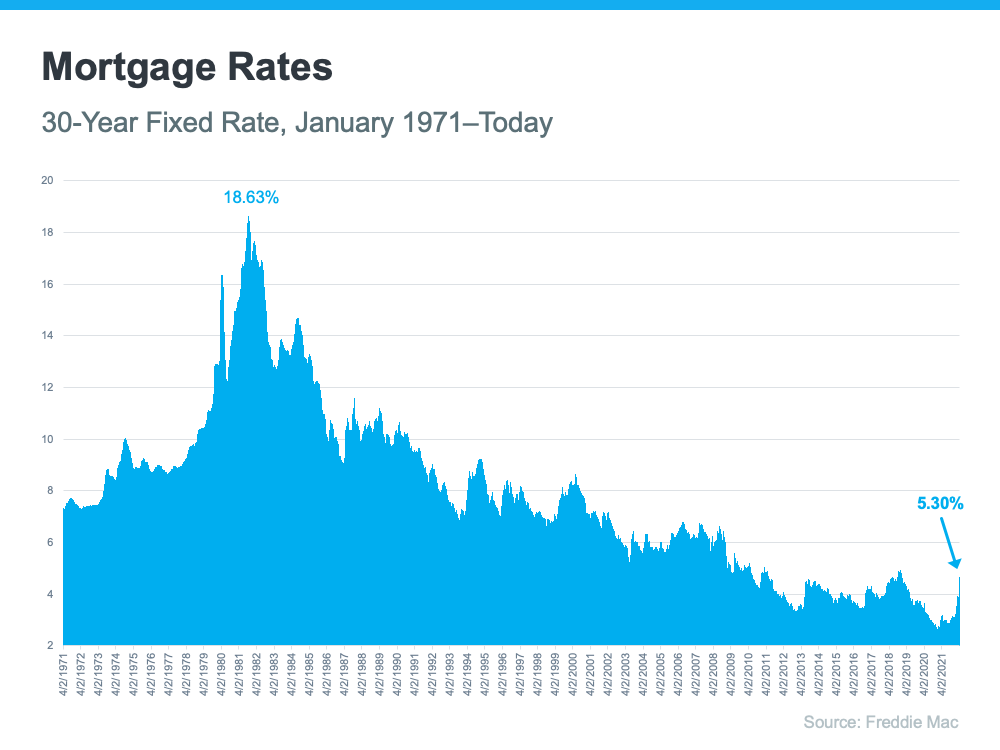
One factor that could help you make your decision to buy now is how today’s mortgage rates compare to historical data. While higher than the average 30-year fixed rate in recent years, the latest rates are still comparatively low when you look at the bigger picture of where rates have been since 1971 (see graph below):

Why Rising Mortgage Rates Push Buyers off the Fence | Simplifying The Market

Mark Fleming, Chief Economist at First American, explains it like this:

“. . . historical context is important. An average 30-year, fixed mortgage rate of 5.5 percent is still well below the historical average of nearly 8 percent.”

If you’re deciding whether to buy now or wait, this is important context to have. Today’s mortgage rate still gives you a window of opportunity to lock in a rate that’s comparatively lower than decades past.

A Look Ahead: What Happens if Rates Climb Further

The buyers who are springing into action now are also motivated to make their move because they know rates have risen steadily this year, and they’re eager to get ahead of any further increases.

Why? When mortgage rates climb, they impact the monthly mortgage payment you’ll have on the home you’re buying. Basically, it’ll likely cost you more to buy a home if you wait. Experts say mortgage rates will rise (although more moderately) in the months ahead. Odeta Kushi, Deputy Chief Economist at First American, explains:

“. . . ongoing inflationary pressure remains likely to push mortgage rates even higher in the months to come.”

So, if you’re ready and financially able to buy now, it may make more sense to get off the fence and make your purchase sooner rather than later. As Nadia Evangelou, Senior Economist at the National Association of Realtors (NAR), says:

With even higher interest rates on the horizon, I don’t see any reason to hold off from purchasing a home right now. If you feel financially secure, you should start looking for a home.”

At the end of the day, there is no perfect advice on when to buy a home. What you should do depends on your goals, your finances, and your personal situation. Use this information with the help of local real estate professionals to make an informed decision on what’s best for you. Bill McBride of Calculated Risk sums it up best:

“. . . if you’re on the fence about whether to buy now or wait for a better deal, buying sooner rather than later might be wise. That said, home buying is always a personal decision. Whether you should buy in 2022 depends on your financial situation and the local housing market where you live.”

Bottom Line

For many buyers, rising mortgage rates are motivating them to act now and make a purchase before rates rise higher. To decide what move is best for you, let’s connect so you have expert advice on your side.

Are There More Homes Coming to the Market?

Are There More Homes Coming to the Market?

Are There More Homes Coming to the Market? | Simplifying The Market

According to a recent survey from the National Association of Realtors (NAR), one of the top challenges buyers face in today’s housing market is finding a home that meets their needs. That’s largely because the inventory of homes for sale is so low today.

If you’re looking to buy a home, you may have noticed this yourself. But there is good news. Recent data shows more sellers are listing their houses this season, which may give you more options for your home search.

Early Signs Inventory May Be Growing

The latest data from realtor.com shows the number of listings coming onto the market, known in the industry as “new listings,” has increased since the start of the year (see graph below):

Are There More Homes Coming to the Market? | Simplifying The Market

This indicates more sellers are listing their homes for sale each month this year. And according to realtor.com, this growth is expected to continue. Their research finds the majority of potential sellers plan to list their homes over the next six months. Realtor.com says:

“. . . markets may see a noticeable bump in the number of homes for sale as we move through spring and into summer. A majority of homeowners planning to sell this year indicated that they aim to list in the next six months, with almost 10% having already placed their properties on the market.”

Homes Are Still Selling Quickly

But while new listings are increasing, it’s important to know they’re also selling quickly. The latest Realtors Confidence Index from NAR shows the median days on market for recently sold homes since the beginning of the year (see chart below). The time on market has decreased month-over-month. That means homes are selling even faster than they did the previous month.

Are There More Homes Coming to the Market? | Simplifying The Market

What That Means for You

While a low-inventory market is difficult to navigate as a buyer, there is hope. The growing number of new listings and the expectation more sellers will list their homes in the coming months is great news if you’ve had a hard time finding a home that fits your needs. Just remember, those new listings are going fast. That means you’ll want to keep your foot on the gas and be ready to act if you find a home you love this season.

Your agent can help you stay on top of the latest listings in your area so you can find the home that’s right for you and submit your strongest offer as quickly as possible.

Bottom Line

If you’ve been having a hard time finding your dream home, stick with your search. More options are coming to market and your ideal home could be one of them. Let’s connect so you can stay up to date on the latest listings in our market, so you can be ready to move fast when you find the one that’s right for you.

Will Home Prices Fall This Year? Here’s What Experts Say.

Will Home Prices Fall This Year? Here’s What Experts Say.

Will Home Prices Fall This Year? Here’s What Experts Say | Simplifying The Market

Many people are wondering: will home prices fall this year? Whether you’re a potential homebuyer, seller, or both, the answer to this question matters for you. Let’s break down what’s happening with home prices, where experts say they’re headed, and how this impacts your homeownership goals.

What’s Happening with Home Prices? 

Home prices have seen 121 consecutive months of year-over-year increases. CoreLogic says:

Price appreciation averaged 15% for the full year of 2021, up from the 2020 full year average of 6%.”

So why are prices climbing so much? It’s because there are more buyers than there are homes for sale. This imbalance is expected to maintain that upward pressure on home prices because homes for sale are a hot commodity in today’s low-inventory housing market.

Where Do Experts Say Prices Will Go from Here?

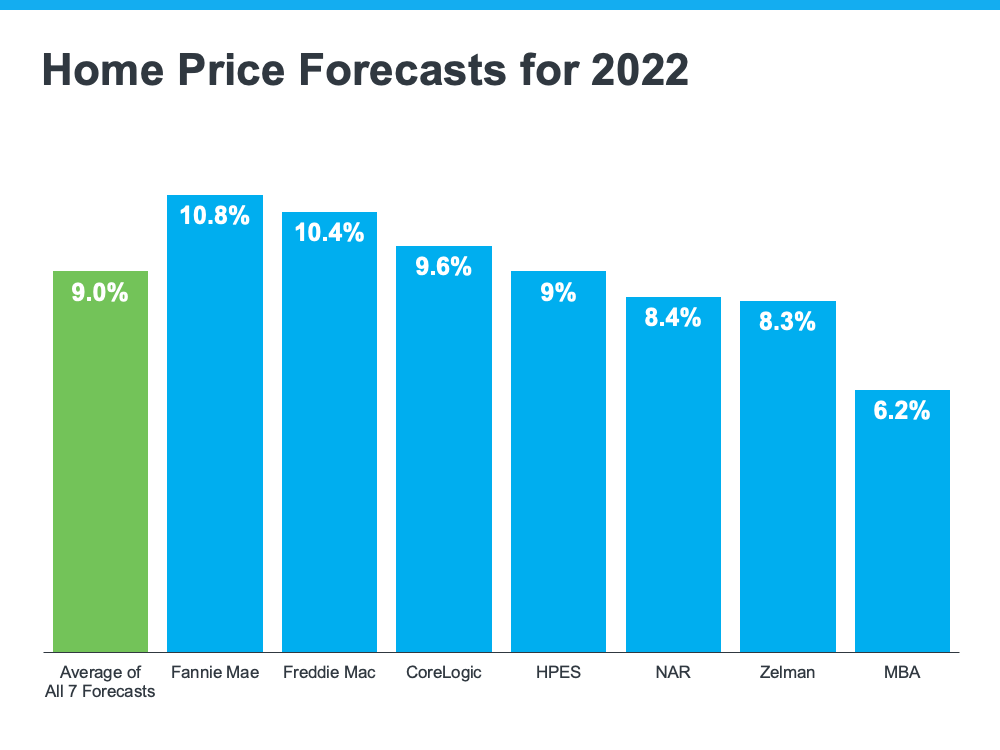
Experts say the housing market isn’t set up for a price decline due to that ongoing imbalance between supply and demand. In the latest home price forecasts for 2022, they’re calling for ongoing appreciation throughout the year (see graph below):

Will Home Prices Fall This Year? Here’s What Experts Say | Simplifying The Market

While the experts are forecasting more moderate price appreciation, the 2022 projections show price gains will remain strong throughout this year. First American explains it like this:

While house price growth is expected to moderate from the rapid pace of 2021, strong home buyer demand against a backdrop of historically tight inventory of homes for sale will likely keep appreciation positive in the coming year.”

What Does That Mean for You?

The biggest takeaway is that none of the experts are projecting depreciation. If you’re a homeowner thinking about selling, the higher price appreciation over the last two years has been great for your home’s value, but it’s also something you should factor in when planning your next steps. If you’ll also be buying a home after selling your current house, you shouldn’t wait for prices to fall. Waiting will only cost you more in the long run because climbing mortgage rates and rising home prices will have an impact on your next home purchase. Freddie Mac says:

“If you’re thinking about waiting until next year and that maybe rates are higher, but you’ll get a deal on prices – well that’s risky. It may be more advantageous to purchase this year relative to waiting until 2023 at this time.”

Bottom Line

If you’re thinking of selling to move up, you shouldn’t wait for prices to fall. Experts say prices will continue to appreciate this year. That means, if you’re ready, buying your next home before prices climb further may make the most financial sense. Let’s connect to begin the process of selling your current home and looking for your next one before prices rise higher.

How Today’s Mortgage Rates Impact Your Home Purchase

How Today’s Mortgage Rates Impact Your Home Purchase

How Today’s Mortgage Rates Impact Your Home Purchase | Simplifying The Market

If you’re planning to buy a home, it’s critical to understand the relationship between mortgage rates and your purchasing power. Purchasing power is the amount of home you can afford to buy that’s within your financial reach. Mortgage rates directly impact the monthly payment you’ll have on the home you purchase. So, when rates rise, so does the monthly payment you’re able to lock in on your home loan. In a rising-rate environment like we’re in today, that could limit your future purchasing power.

Today, the average 30-year fixed mortgage rate is above 5%, and in the near term, experts say that’ll likely go up in the months ahead. You have the opportunity to get ahead of that increase if you buy now before that impacts your purchasing power.

Mortgage Rates Play a Large Role in Your Home Search

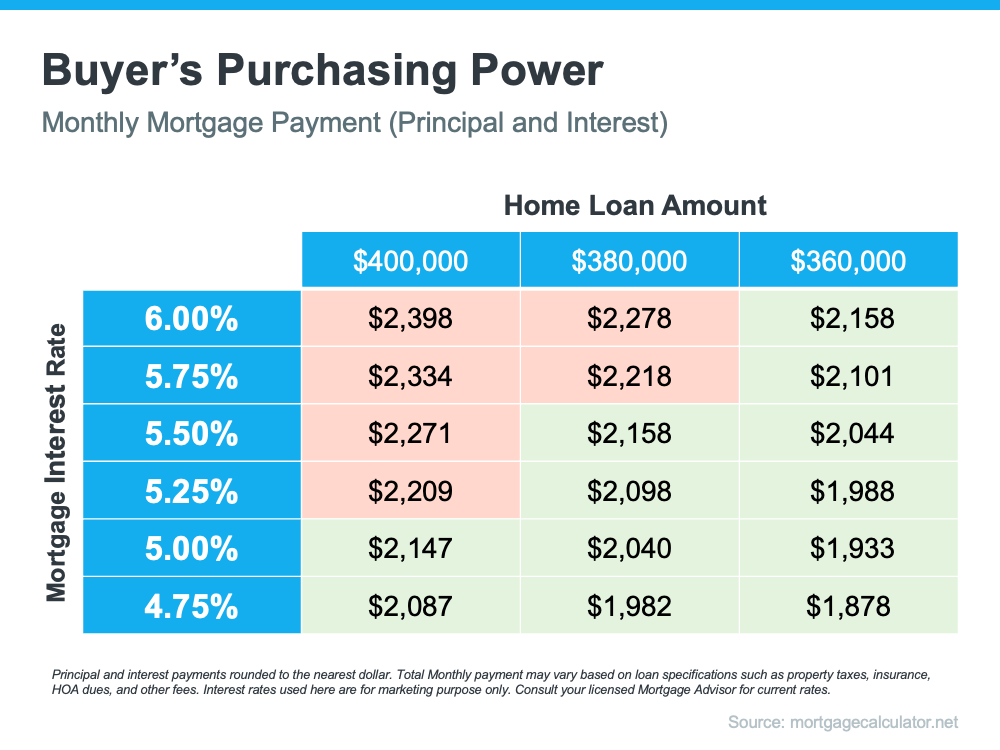
The chart below can help you understand the general relationship between mortgage rates and a typical monthly mortgage payment within a range of loan amounts. Let’s say your budget allows for a monthly mortgage payment in the $2,100-$2,200 range. The green in the chart indicates a payment within that range, while the red is a payment that exceeds it (see chart below):

How Today’s Mortgage Rates Impact Your Home Purchase | Simplifying The Market

As the chart shows, you’re more likely to exceed your target payment range as mortgage rates increase unless you pursue a lower home loan amount. If you’re ready to buy a home, use this as your motivation to purchase now so you can get ahead of rising rates before you have to make the decision to decrease what you borrow in order to stay comfortably within your budget.

Work with Trusted Advisors To Know Your Budget and Make a Plan

It’s critical to keep your budget top of mind as you’re searching for a home. Danielle Hale, Chief Economist at realtor.com, puts it best, advising that buyers should:

Get preapproved with where rates are today, but also consider what would happen if rates were to go up, say another quarter of a point, . . . Know what that would do to your monthly costs and how comfortable you are with that, so that if rates do move higher, you already know how you need to adjust in response.”

No matter what, the best strategy is to work with your real estate advisor and a trusted lender to create a plan that takes rising mortgage rates into consideration. Together, you can look at your budget based on where rates are today and craft a strategy so you’re ready to adjust as rates change.

Bottom Line

Even small increases in mortgage rates can impact your purchasing power. If you’re in the process of buying a home, it’s more important than ever to have a strong plan. Let’s connect so you have a trusted real estate advisor and a lender on your side who can help you strategize to achieve your dream of homeownership this season.

Pin It on Pinterest