Happy married couple talking with financial advisor on a meeting in the office
Are you looking to buy a home? If so, we’ve got good news for you.
While there’s no denying the housing market is having a great year, many of the headlines are focused on the perks for sellers. But what about buyers today? As a buyer, you’re likely braving bidding wars and weighing low mortgage rates versus price appreciation as you search for your dream home. If you find yourself a bit discouraged, hear this: there are clear signs buyers may have more opportunities this fall.
According to realtor.com, the sweet spot for buyers is just around the corner. In a recent study, experts analyzed housing market trends by looking at data from the past several years. When applied to the current market, experts determined the ideal week to buy a home this year. The research says:
“Nationally, the best time to buy in 2021 is the week of October 3-9. This week historically has shown the best balance of market conditions that favor buyers.”
So, what’s that mean for you? If you’re looking to buy a home, there’s a golden window of opportunity coming. Here’s what you can expect from that week.
Increased Housing Supply
The number of homes available for sale should increase. According to realtor.com, you can expect to see more new listings come to market the week of October 3. The findings estimate we’ll see roughly 17.6% more homes available than we saw at the start of the year.
This means you’ll have more options to choose from which should be a welcome relief in a market with tight housing supply.
Fewer Bidding Wars
With more homes available, you should also see a slight decline in the number of bidding wars. Having more options means buyers may not be competing as intensely for the homes on the market because there are more choices to go around.
This means when you write an offer, you may have less competition and a better chance of being the top bid. Just remember, it’s still important to come in with a strong offer.
Adjusted Homes Prices
As we move into the end of the year, the findings from realtor.com note this week may also be one of the peak weeks for price reductions in 2021. Historically the data shows an average of 7.0% of homes have a price reduction that week. Why? When housing supply ticks up, sellers need to look for other ways to make their house stand out.
This means, while home prices are still appreciating overall, you may see some homes with price adjustments from eager sellers. The process of closing a house takes time. To close before end of year, sellers may be more motivated this October.
Bottom Line
If you’re in the market for a home, don’t lose steam now. Data shows early October may give you the long-awaited opportunity to find the home of your dreams. Let’s connect so you have a trusted ally and advisor to help keep you motivated so you can find the perfect home for you.
Shot of a relaxed couple enjoying the day at home together
In today’s real estate market, buyers shouldn’t shop for a home with the expectation they’ll be able to negotiate a lower sales price. In a typical housing market, buyers try to determine how much less than the asking price they can offer and still get the home. From there, the buyer and seller typically negotiate and agree on a revised price somewhere in the middle.
Homes selling quickly and receiving multiple offers highlights how competitive the housing market is right now. This is due, in large part, to the low supply of homes for sale. Low supply and high demand mean homes often sell for more than the asking price. In some cases, they sell for a lot more. Selma Hepp, Deputy Chief Economist at CoreLogic, explains how these stats can impact buyers:
“The imbalance between robust demand and dismal availability of for-sale homes has led to a continual bidding over asking prices, which reached record levels in recent months. Now, almost 6 in 10 homes listed are selling over the asking price.”
You May Need To Rethink How You Look at a Home’s Asking Price
What does that mean for you? If you’ve found your dream home, you need to be realistic about today’s housing market and how that impacts the offer you’ll make. Offering below or even at a home’s asking price may not cut it. In today’s market, the highest bidder often wins the home, much like at an auction.
Currently, the asking price is often the floor of the negotiation rather than the ceiling. If you really love a home, it may ultimately sell for more than the sellers are asking. That’s important to keep in mind as you work with your agent to craft an offer.
Understand An Appraisal Gap Can Happen
Because of today’s home price appreciation and the auction-like atmosphere in the selling process, appraisal gaps – the gap between the price of your contract and the appraisal for the house – are more frequent.
“Beginning in January 2020, nationally, 7% of purchase transactions had a contract price above the appraisal, but by May 2021, the frequency had increased to 19% of purchase transactions.”
When this happens, your lender won’t loan you more than the home’s appraised value, and the seller may ask you to make up the difference out of pocket. Buyers in today’s market need to be prepared for this possibility. Know your budget, know what you can afford, and work with a trusted advisor who can offer expert advice along the way.
Bottom Line
Bidding wars and today’s auction-like atmosphere mean buyers need to rethink how they look at the asking price of a home. Let’s connect so you have a trusted real estate professional who can advise you on the current market and help determine what the market value is on your dream home.
Weekend fun at home together. Rear view of a mixed race couple standing in the garden, embracing and looking at the house
If you’re a renter with a desire to become a homeowner, or a homeowner who’s decided your current house no longer fits your needs, you may be hoping that waiting a year might mean better market conditions to purchase a home.
To determine if you should buy now or wait, you need to ask yourself two simple questions:
What will home prices be like in 2022?
Where will mortgage rates be by the end of 2022?
Let’s shed some light on the answers to both of these questions.
What will home prices be like in 2022?
Three major housing industry entities project continued home price appreciation for 2022. Here are their forecasts:
Using the average of the three projections (6.27%), a home that sells for $350,000 today would be valued at $371,945 by the end of next year. That means, if you delay, it could cost you more. As a prospective buyer, you could pay an additional $21,945 if you wait.
Where will mortgage rates be by the end of 2022?
Today, the 30-year fixed mortgage rate is hovering near historic lows. However, most experts believe rates will rise as the economy continues to recover. Here are the forecasts for the fourth quarter of 2022 by the three major entities mentioned above:
That averages out to 3.7% if you include all three forecasts, and it’s nearly a full percentage point higher than today’s rates. Any increase in mortgage rates will increase your cost.
What does it mean for you if both home values and mortgage rates rise?
You’ll pay more in mortgage payments each month if both variables increase. Let’s assume you purchase a $350,000 home this year with a 30-year fixed-rate loan at 2.86% after making a 10% down payment. According to the mortgage calculator from Smart Asset, your monthly mortgage payment (including principal and interest payments, and estimated home insurance, taxes in your area, and other fees) would be approximately $1,899.
That same home could cost $371,945 by the end of 2022, and the mortgage rate could be 3.7% (based on the industry forecasts mentioned above). Your monthly mortgage payment, after putting down 10%, would increase to $2,166.
The difference in your monthly mortgage payment would be $267. That’s $3,204 more per year and $96,120 over the life of the loan.
If you consider that purchasing now will also let you take advantage of the equity you’ll build up over the next calendar year, which is approximately $22,000 for a house with a similar value, then the total net worth increase you could gain from buying this year is over $118,000.
Bottom Line
When asking if you should buy a home, you probably think of the non-financial benefits of owning a home as a driving motivator. When asking when to buy, the financial benefits make it clear that doing so now is much more advantageous than waiting until next year.
Businessman looking at smartphone while sitting at counter in office coworking space working on project on laptop
A lot has changed over the past year. For many people, the rise in remote work influenced what they’re looking for in a home and created a greater appetite for a dedicated home office. Some professionals took advantage of the situation and purchased a bigger home. Other people thought working from home would be temporary, so they chose to get creative and make the space they already had work for them. But recent headlines indicate working from home isn’t a passing fad.
If you’re still longing for a dedicated home office, now may be the time to find the home that addresses your evolving needs. More and more companies are delaying their plans to return to the office – others are deciding to remain fully remote permanently. According to economists from Goldman Sachs in a recent article from CNN:
“Job ads increasingly offer remote work and surveys indicate that both workers and employers expect work from home to remain much more common than before the pandemic.”
Other experts agree. A survey conducted by Upwork of 1,000 hiring managers found that due to the pandemic, companies were planning more remote work now and in the years to come. Upwork elaborates:
“The number of remote workers in the next five years is expected to be nearly double what it was before COVID-19: By 2025, 36.2 million Americans will be remote, an increase of 16.8 million people from pre-pandemic rates.”
The charts below break down their findings and compare pre- and post-pandemic percentages.
How Does This Impact Homeowners?
If you own your home, it’s important to realize that continued remote work may give you opportunities you didn’t realize you had. Since you don’t need to be tied to a specific area for your job, you have more flexibility when it comes to where you can live.
If you’re one of the nearly 23% of workers who will remain 100% remote:
You have the option to move to a lower cost-of-living area or to the location of your dreams. If you search for a home in a more affordable area, you’ll be able to get more home for your money, freeing up more options for your dedicated office space and additional breathing room.
You could also move to a location where you’ve always wanted to live – somewhere near the beach, the mountains, or simply a market that features the kind of weather and community amenities you’re looking for. Without your job tying you to a specific location, you’re bound to find your ideal spot.
If you’re one of the almost 15% of individuals who will have a partially remote or hybrid schedule:
Relocating within your local area to a home that’s further away from your office could be a great choice. Since you won’t be going in to work every day, a slightly longer commute from a more suburban or rural neighborhood may be a worthy trade-off for a home with more features, space, or comforts.
Bottom Line
If ongoing remote work is changing what you need in a home, let’s connect to find one that delivers on your new wish list.
If you’ve been in your home for longer than five years, you’re not alone. According to recent data from First American, homeowners are staying put much longer than historical averages (see graph below):As the graph shows, before 2008, homeowners sold their houses after an average of just five years. Today, that number has more than doubled to over 10 years. The housing industry refers to this as your tenure.
To really explore tenure, it’s important to understand what drives people to make a move. An article from The Balance explores some of the primary reasons individuals choose to sell their houses. It says:
“People who move for home-related reasons might need a larger home or a house that better fits their needs, . . . Financial reasons for moving include wanting a nicer home, moving to a newer home to avoid making repairs on the old one, or cashing in on existing equity.”
If you’ve been in your home for longer than the norm, chances are you’re putting off addressing one, if not several, of the reasons other individuals choose to move. If this sounds like you, here are a few things to consider:
If your needs have changed, it may be time to re-evaluate your home.
As the past year has shown, our needs can change rapidly. That means the longer you’ve been in your home, the more likely it is your needs have evolved. The Balance notes several personal factors that could lead to your home no longer meeting your needs, including relationship and job changes.
For example, many workers recently found out they’ll be working remotely indefinitely. If that’s the case for you, you may need more space for a dedicated home office. Other homeowners choose to sell because the number of people living under their roof changes. Now more than ever, we’re spending more and more time at home. As you do, consider if your home really delivers on what you need moving forward.
It’s often financially beneficial to sell your house and move.
One of the biggest benefits of homeownership is the equity your home builds over time. If you’ve been in your house for several years, you may not realize how much equity you have. According to the latest Homeowner Equity Report from CoreLogic, homeowners gained an average of $33,400 in equity over the past year.
That equity, plus today’s low mortgage rates, can fuel a major upgrade when you sell your home and purchase a new one. Or, if you’re looking to downsize, your equity can help provide a larger down payment and lower your monthly payments over the life of your next loan. No matter what, there are significant financial benefits to selling in today’s market.
Bottom Line
If you’ve been in your home for 5-10 years or more, now might be the time to explore your options. Today’s low rates and your built-up equity could provide you with the opportunity to address your evolving needs. If you feel it’s time to sell, let’s connect.
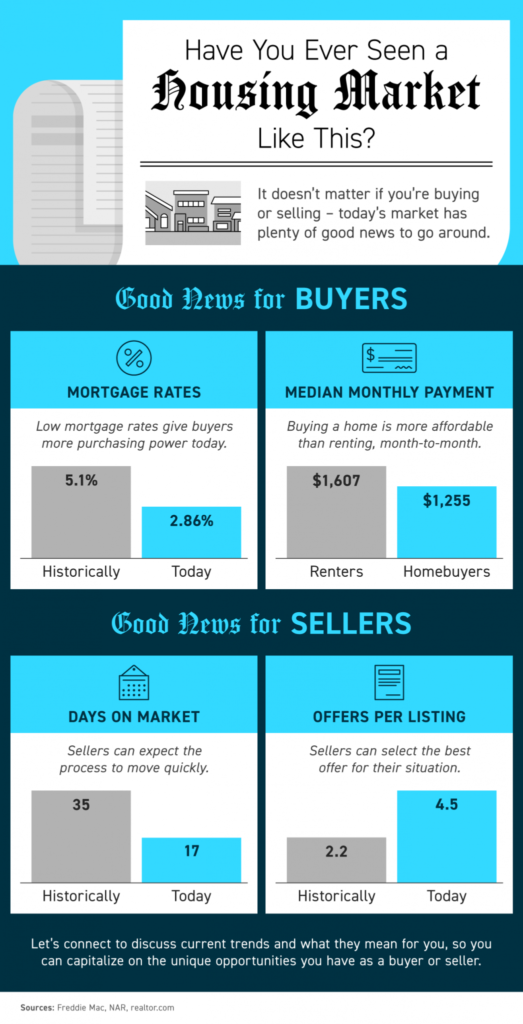
Whether you’re buying or selling – today’s housing market has plenty of good news to go around.
Buyers can take advantage of today’s mortgage rates to escape rising rents and keep monthly payments affordable. Sellers can reap the benefits of multiple offers and a fast sale.
If this sounds like good news to you, let’s connect today so you can capitalize on the unique opportunity you have in today’s market.







![Have You Ever Seen a Housing Market Like This? [INFOGRAPHIC]](https://housingcoach.com/wp-content/uploads/2021/10/image-3-1046x675.png)