What Does the Future Hold for Home Prices?

What Does the Future Hold for Home Prices?

What Does the Future Hold for Home Prices? | Simplifying The Market

If you’re looking to buy or sell a house, chances are you’ve heard talk about today’s rising home prices. And while this increase in home values is great news for sellers, you may be wondering what the future holds. Will prices continue to rise with time, or should you expect them to fall?

To answer that question, let’s first understand a few terms you may be hearing right now.

It’s important to note home prices have increased, or appreciated, for 114 straight months. To find out if that trend may continue, look to the experts. Pulsenomics surveyed over 100 economists, investment strategists, and housing market analysts asking for their five-year projections. In terms of what lies ahead, experts say the market may see some slight deceleration, but not depreciation.

Here’s the forecast for the next few years:What Does the Future Hold for Home Prices? | Simplifying The MarketAs the graph above shows, prices are expected to continue to rise, just not at the same pace we’ve seen over the last year. Over 100 experts agree, there is no expectation for price depreciation. As the arrows indicate, each number is an increase, which means prices will rise each year.

Bill McBride, author of the blog Calculated Risk, also expects deceleration, but not depreciation:

“My sense is the Case-Shiller National annual growth rate of 19.7% is probably close to a peak, and that year-over-year price increases will slow later this year.”

Ivy Zelman of Zelman & Associates agrees, saying:

“. . . home price appreciation is on the cusp of flipping to a decelerating trend.”

A recent article from realtor.com indicates you should expect:

“. . . annual price increases will slow to a more normal level, . . .”

What Does This Deceleration Mean for You?

What experts are projecting for the years ahead is more in line with the historical norm for appreciation. According to data from Black Knight, the average annual appreciation from 1995-2020 is 4.1%. As you can see from the chart above, the expert forecasts are closer to that pace, which means you should see appreciation at a level that’s aligned with a more normal year.

If you’re a buyer, don’t expect a sudden or drastic drop in home prices – experts say it won’t happen. Instead, think about your homeownership goals and consider purchasing a home before prices rise further.

If you’re a seller, the continued home price appreciation is good news for the value of your house. Work with an agent to list your house for the right price based on market conditions.

Bottom Line

Experts expect price deceleration, not price depreciation over the coming years. Let’s connect to talk through what’s happening in the housing market today, where things are headed, and what it means for you.

Ready To Sell, but Don’t Know Where You’ll Go? [INFOGRAPHIC]

Ready To Sell, but Don’t Know Where You’ll Go? [INFOGRAPHIC]

Some Highlights

  • If you’re thinking of selling your house but don’t know what you should buy, you have options.
  • Existing homes offer a wide variety of home styles, an established neighborhood, and lived-in charm. Meanwhile, new home construction lets you create your perfect home, cash in on energy efficiency, and minimize repairs.
  • Whether you’re looking for newly built or existing homes, both have their perks. If you’re ready to sell your house, let’s connect today to go over the perks of both existing and newly built homes to find out what’s right for you.
Sellers: Your House Could Be an Oasis for Buyers Seeking More Options

Sellers: Your House Could Be an Oasis for Buyers Seeking More Options

Sellers: Your House Could Be an Oasis for Buyers Seeking More Options | Simplifying The Market

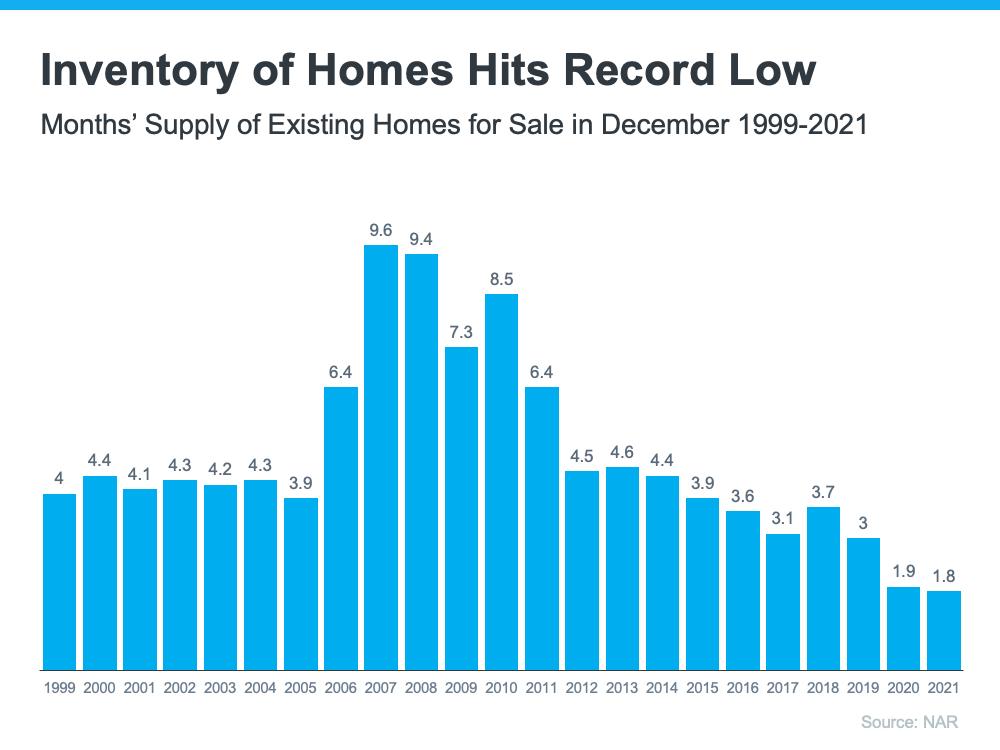
Sellers have a great opportunity this season as buyer demand still heavily outweighs the current supply of homes for sale. According to the National Association of Realtors (NAR), today’s housing inventory sits at only a 2.6-month supply. To put that into perspective, a neutral market typically features a 6-month supply. That places today’s market firmly in the sellers’ market category.

That same NAR data also shows today’s inventory of single-family homes is trailing behind the level we saw last year (see graph below):Sellers: Your House Could Be an Oasis for Buyers Seeking More Options | Simplifying The MarketBecause of the ongoing supply challenges, buyers can feel like they’re wandering across a vast, empty desert when searching for their next home. That means your house could provide an oasis for buyers thirsty for options – and it could increase the chances of buyers entering a bidding war for your home.

The latest Realtors Confidence Index Survey from NAR shows houses are receiving an average of 3.8 offers. A multiple-offer scenario lets you select the best offer and gives you incredible leverage when you sell this fall.

Bottom Line

Buyers today are looking for relief as they wander today’s inventory desert. Listing your house this fall – before more options appear – gives your house the best chance to be noticed by multiple buyers. Let’s connect today so your house can stand out as the oasis it truly is.

What Do Past Years Tell Us About Today’s Real Estate Market?

What Do Past Years Tell Us About Today’s Real Estate Market?

What Do Past Years Tell Us About Today’s Real Estate Market? | Simplifying The Market

As you follow the news, you’re likely seeing headlines discussing what’s going on in today’s housing market. Chances are high that some of the more recent storylines you’ve come across mention terms like cooling or slowing when talking about where the market is headed.

But what do these terms mean? The housing market today is anything but normal, and it’s still an incredibly strong sellers’ market, especially when compared to the few years leading up to the pandemic. With that in mind, what can previous years tell us about today’s real estate market and if it’s truly slowing?

We’re Still Seeing an Above Average Number of Sales

You may see headlines about a drop in home sales. But are those headlines telling the full story? The most recent Existing Home Sales Report from the National Association of Realtors (NAR) does show a drop of about 2% from July to August. But the month-over-month decline doesn’t provide the full picture (see graph below):What Do Past Years Tell Us About Today’s Real Estate Market? | Simplifying The MarketAs the graph shows, historical context is key. Today’s home sales are well ahead of some of the more normal years that led up to the health crisis. That means buyers are still in the market, which is great news if you’re planning to list your home.

Houses Are Selling Faster Than Usual

When headlines mention the market is slowing, sellers may naturally wonder if their house will sell as quickly as they’d like. According to the most recent Realtors Confidence Index from NAR, homes are still selling at record speed (see graph below):What Do Past Years Tell Us About Today’s Real Estate Market? | Simplifying The MarketAgain, if we look back at data from previous years, we can see the average time on market17 days –  means homes are selling faster than a normal pace.

Bidding Wars Are Still the Norm

The Realtors Confidence Index from NAR also shows a drop in the average number of offers homes are receiving in August, and many headlines may simply focus there without providing the important context (see graph below):What Do Past Years Tell Us About Today’s Real Estate Market? | Simplifying The MarketAgain, it’s important to compare today’s market to trends from recent years. Currently, the average number of offers per listing is higher than 39 of the previous 45 months. That means the likelihood of a bidding war on your home is still high. And the number of offers your house receives can have a major influence on the final sale price.

So, Is the Market Slowing Down?

While there are slight declines in various month-to-month data, it’s important to keep historical context in mind when determining what’s happening in today’s market. Odeta Kushi, Deputy Chief Economist at First American, put it best recently, saying:

“It’s not the white-hot market from earlier in the year & it’s not the 2020 market benefiting from a wave of pent-up demand but make no mistake this is still a hot housing market.”

Bottom Line

Don’t let headlines make you rethink listing your home this fall. Selling today means you can still take advantage of high buyer demand, multiple offers, and a quick sale. If you’re thinking of selling your house, let’s connect and discuss why this fall is the perfect time to do so.

The Big Question: Should You Renovate or Move?

The Big Question: Should You Renovate or Move?

The Big Question: Should You Renovate or Move? | Simplifying The Market

The last 18 months changed what many buyers are looking for in a home. Recently, the American Institute of Architects released their AIA Home Design Trends Survey results for Q3 2021. The survey reveals the following:

  • 70% of respondents want more outdoor living space
  • 69% of respondents want a home office (48% wanted multiple offices)
  • 46% of respondents want a multi-function room/flexible space
  • 42% of respondents want an au pair/in-law suite
  • 39% of respondents want an exercise room/yoga space

If you’re a homeowner who wants to add any of the above, you have two options: renovate your current house or buy a home that already has the spaces you desire. The decision you make could be determined by factors like:

  1. A possible desire to relocate
  2. The difference in the cost of a renovation versus a purchase
  3. Finding an existing home or designing a new home that has exactly what you want (versus trying to restructure the layout of your current house)

In either case, you’ll need access to capital: the funds for the renovation or the down payment your next home would require. The great news is that the money you need probably already exists in your current home in the form of equity.

Home Equity Is Skyrocketing

The record-setting increases in home prices over the last two years dramatically improved homeowners’ equity. The graph below uses data from CoreLogic to show the average home equity gain in the first quarter of the last nine years:The Big Question: Should You Renovate or Move? | Simplifying The MarketOdeta Kushi, Deputy Chief Economist at First American, quantifies the amount of equity homeowners gained recently:

“Remember U.S. households own nearly $35 trillion in owner-occupied real estate, just over $11 trillion in debt, and the remaining ~$24 trillion in equity. In inflation adjusted terms, homeowners in Q2 had an average of $280,000 in equity- a historic high.”

As a homeowner, the money you need to purchase the perfect home or renovate your current house may be right at your fingertips. However, waiting to make your decision may increase the cost of tapping that equity.

If you decide to renovate, you’ll need to refinance (or take out an equity loan) to access the equity. If you decide to move instead and use your equity as a down payment, you’ll still need to mortgage the remaining difference between the down payment and the cost of your next home.

Mortgage rates are forecast to increase over the next year. Waiting to leverage your equity will probably mean you’ll pay more to do so. According to the latest data from the Federal Housing Finance Agency (FHFA), almost 57% of current mortgage holders have a mortgage rate of 4% or below. If you’re one of those homeowners, you can keep your mortgage rate under 4% by doing it now. If you’re one of the 43% of homeowners with a mortgage rate over 4%, you may be able to do a cash-out refinance or buy a more expensive home without significantly increasing your monthly payment.

First Step: Determine the Amount of Equity in Your Home

If you’re ready to either redesign your current house or find an existing or newly constructed home that has everything you want, the first thing you need to do is determine how much equity you have in your current home. To do that, you’ll need two things:

  1. The current mortgage balance on your home
  2. The current value of your home

You can probably find the mortgage balance on your monthly mortgage statement. To find the current market value of your house, you can pay several hundreds of dollars for an appraisal, or you can contact a local real estate professional who will be able to present to you, at no charge, a professional equity assessment report.

Bottom Line

If the past 18 months have refocused your thoughts on what you want from your house, now may be the time to either renovate or make a move to the perfect home.

Home Seller Services

Home Seller Services

The HousingCoach at United Real Estate - Chicago

Home Seller Services

The HousingCoach℠ Approach to Home Seller Services is very systematic. There are lots of moving parts in a home sale and even more moving parts if there is a home purchase to be orchestrated as part of this transition. There are both practical and emotional components that need to be identified and planned for in order to have the most successful upgrade or downgrade transition.

All of our services start with a quick 15 – 30 minute coaching call which is a basic introductory consultation. On that call you take out your dream paint brush and start painting a picture of what the next phase or your American Dream looks like and I will ask you some specific questions about your plans, circumstances, and qualifications. If we both decide at the end of that call that we should move to the next stage, we will schedule your Comprehensive Home Seller Consultation.

As your HousingCoach℠ I will help you to develop and solid home sales game plan which will incorporate your current circumstances and your plans, goals, and dreams for the next 5, 10, or even 20 or more years into the future. In the Comprehensive Home Seller Consultation we will dive into Home Sale Profits, the Transactional Costs, and financial realities of the transition from your current house to your next home.

Once we decide to work together I will help you to:

  • Build out your Home Selling Game Plan;
  • Assemble your Home Selling (and if applicable, your Home Buying )Real Estate Team;
  • Customize and implement Your Comprehensive HousingCoach Marketing Plan;
  • Coordinate Home Showing Activity;
  • Procure Buyer Feedback;
  • Track and communicate all pertinent market activity to you during the sales process;
  • Make appropriate recommendations on any plan or pricing changes the market dictates;
  • Actively invite offers from all buyers through their agents;
  • Analyze all offers and buyer qualifications as they come in;
  • Develop, with you, a negotiation strategy for each and every offer;
  • Negotiate on your behalf to get the best possible deal;
  • Coordinate all of the transaction requirements and activities until the deal is closed.

If we work together I can promise you that we will have some laughs along the way without losing sight of the fact that Home Selling is serious business. It should be done only after the research is done, all aspects of your sale have been planned out,  you have a well crafted strategy to transition to your destination, and have assembled an experienced team of real estate professionals to help you on both ends.

Schedule your Quick Coaching Call now and let’s discuss how to make your American Dream a reality.


Pin It on Pinterest